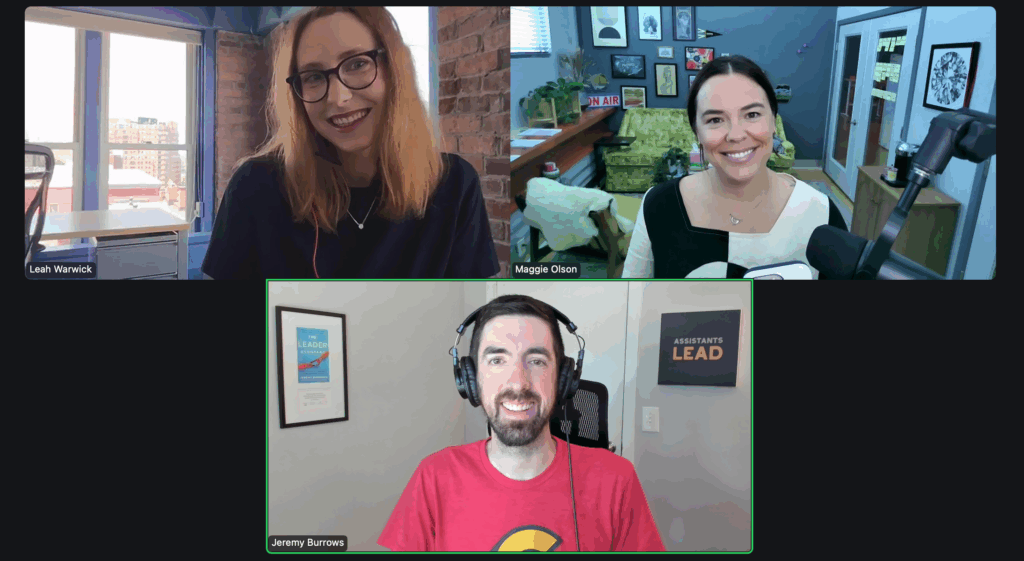
Leah Warwick is the senior content manager for the American Society of Administrative Professionals (ASAP). Maggie Olson is the Founder of Nova Chief of Staff, the premier destination for Chief of Staff education and development.
In this episode of The Leader Assistant Podcast, I talk with Leah and Maggie about the state of the administrative profession, skill gaps, professional development, and more.
LEADERSHIP QUOTE
The growth and development of people is the highest calling of leadership.
— Harvey Firestone
CONNECT WITH LEAH

ABOUT LEAH
Leah Warwick is the senior content manager for the American Society of Administrative Professionals (ASAP). Supporting 110,000 members and growing, ASAP provides role-specific training, community, and resources for executive assistants and administrative professionals. ASAP offers the Professional Administrative Certification of Excellence (PACE) and produces annual in-person training events such as the Administrative Professionals Conference (APC) and EA Ignite.
—
CONNECT WITH MAGGIE
- Maggie on LinkedIn
- Nova’s Resource Library
- Nova Chief of Staff Certification Course
- Other episodes featuring Maggie:

ABOUT MAGGIE
Maggie Olson is the Founder of Nova Chief of Staff, the premier and first-of-its-kind destination for Chief of Staff education, certification, and development. She has 20 years of experience in retail, food and beverage, and technology sectors and has held leadership roles at Nordstrom and T-Mobile. At T-Mobile, Maggie’s impressive work led her to become the first Chief of Staff to the President of the T-Mobile Business Group. In this role, she built the Chief of Staff model from the ground up, creating a highly efficient team and establishing an executive back-office structure, supporting the President, SVPs, and over 5,000 employees. She also built a Chief of Staff team, defining all roles, processes, and systems. Through Nova Chief of Staff, Maggie continues to shape the future of business leadership, providing the tools and resources necessary for Chiefs of Staff and strategic operators to excel in their roles and drive company success.
–––
THE LEADER ASSISTANT ACADEMY
Enroll in the on-demand, AI-powered professional development resource for Leader Assistants who want to level up. Learn more -> The Leader Assistant Academy.
THE LEADER ASSISTANT PREMIUM MEMBERSHIP
To learn more about how you can join growth-minded Leader Assistants, check out our Leader Assistant Premium Membership for ongoing training, coaching, and community.
THE LEADER ASSISTANT BOOK
Download the first 3 chapters of The Leader Assistant: Four Pillars of Game-Changing Assistant for FREE here or buy it on Amazon and listen to the audiobook on Audible. Also, check out the companion study guide, The Leader Assistant Workbook, to dig deeper.
LEADER ASSISTANT LIVE EVENTS
Check out our constantly updated schedule of events for admins and assistants at LeaderAssistantLive.com.
JOIN THE FREE COMMUNITY
Join the Leader Assistant Global Community for bonus content, job opportunities, and to network with other assistants who are committed to becoming leaders!
SUBSCRIBE
Subscribe to The Leader Assistant Podcast so you don’t miss new episodes!
You can find the show on Apple Podcasts, Spotify, Google Podcasts, Pandora, and Stitcher.
Join my email list here if you want to get an email when a new episode goes live.
LEAVE A REVIEW
If you’re enjoying the podcast, please take 2 minutes to rate and review the show on Apple Podcasts here. Each review helps me stay motivated to keep the show going!
THE LEADER ASSISTANT BOOK
Download the first 3 chapters of The Leader Assistant: Four Pillars of Game-Changing Assistant for FREE here or buy it on Amazon and listen to the audiobook on Audible. Also, check out the companion study guide, The Leader Assistant Workbook, to dig deeper.
LEADER ASSISTANT LIVE EVENTS
Check out our constantly updated schedule of events for admins and assistants at LeaderAssistantLive.com.
JOIN THE FREE COMMUNITY
Join the Leader Assistant Global Community for bonus content, job opportunities, and to network with other assistants who are committed to becoming leaders!
SUBSCRIBE
Subscribe to The Leader Assistant Podcast so you don’t miss new episodes!
You can find the show on Apple Podcasts, Spotify, Google Podcasts, Pandora, and Stitcher.
Join my email list here if you want to get an email when a new episode goes live.
LEAVE A REVIEW
If you’re enjoying the podcast, please take 2 minutes to rate and review the show on Apple Podcasts here. Each review helps me stay motivated to keep the show going!
–––
EPISODE TRANSCRIPT
Leah Warwick 0:00
Hi. My name is Leah Warwick, and today’s leadership quote comes from Harvey Firestone, and it is the growth and development of people is the highest calling of leadership.
Podcast Intro 0:20
The Leader Assistant Podcast exists to encourage and challenge assistants to become confident, Game Changing leader assistants.
Jeremy Burrows 0:37
Hey friends, welcome to The Leader Assistant Podcast. It’s episode 343 you can check out the show notes for this episode at leaderassistant.com/343, again, leaderassistant.com/343, you can find all the links and bios and all the things related to this episode there. So really excited to have two guests today. I know it’s very rare that I have two guests on the show, so this would be a fun, fun conversation. So first of all, Maggie Olson has been on the show many times. Hopefully, you know her already, and you know her well. She’s the founder of Nova, Chief of Staff, and she was on several episodes, Episode 257, is one I wanted to call out where she talks about the kind of transition, or the leveling up from EA to Chief of Staff. That’s a really good one. Episode 257, and then another one is navigating the EA and Chief of Staff relationship to 60 that was another one of the more popular episodes where she was on the show. And then the kind of the intro to this community was episode 231 so episode 231 was kind of the Maggie story and introducing her to the leader assistant community. So those are a few episodes. I highly recommend checking out to hear more about Maggie story. But Maggie, welcome back to the show.
Maggie Olson 2:08
Thank you. Happy to be here. I’m excited to dive in with you and your other guest,
Jeremy Burrows 2:13
awesome, awesome. And speaking of My other guest, I’m excited to have Leah Warwick. Leah is the Senior Content Manager at the American Society of Administrative Professionals, also known as ASAP. And ASAP is an organization that provides training and resources for Administrative Professionals. And Leah has been awesome to work with. We just finished up our event in Seattle, and that was a fun time with all of you ministry professionals in Seattle. So, Leah, welcome to the show. This is your first time on the show, so we’re excited to have you. So the first thing I’d love for you to share is the first two things, one, what city you’re in, and two, what do you love to do when you’re not working?
Leah Warwick 3:00
Well, Hi, Jeremy, it’s so great to be here with you and Maggie, I am located in Portland, Maine, and remind me of your second
Jeremy Burrows 3:11
question. No, that’s great. I sometimes do that. I’ll ask 2345, questions and one question, and it screws people up and I don’t even realize it. So apologies. So the second question was, what do you love to do when you’re not working?
Leah Warwick 3:27
Oh, when I’m not working? Well, I am a cinephile, so I love movies, and so I love to watch whatever is coming out. I’m really big into indie cinema.
Jeremy Burrows 3:41
Okay, nice, nice. Is there like, a really, like, Great movie you’ve seen in the last year that’s kind of top of your list? Like, you’re like, I’m gonna see that again and again.
Leah Warwick 3:51
I really like Sean Baker movies. So even though Annora is not my favorite of all the movies that he’s done, I really, really enjoyed that one. It was an Oscar winner. So if you’re into that kind of thing, I recommend it.
Jeremy Burrows 4:04
Awesome. Great. Thanks for the recommendation. Well, tell us a little bit about we’re so just kind of at a high level. We’re going to talk about the state of the administrative profession. We’re going to talk about this extensive report that ASAP, put together called the state of the profession report. And we’ve got lots of data numbers and topics to go into on this interview, but before we dive into all of that, I just wanted to hear a little bit about you, Leah, and how you your career journey and how you ended up working in the administrative professional industry.
Leah Warwick 4:40
Sure. So, like many people, I have worked in the administrative profession. I worked at a temp agency while I was in college, and worked a great number of administrative roles, and I ended up transitioning into arts journalism and B to B media. A and I was a film critic for a while, and then I found myself working for business communities, looking at what their struggles are and how to help solve for them. And that’s how I came to working with ASAP, and now it’s just such a pleasure to work with the Administrative Professionals community here at ASAP, really dive into the data and the problems and the issues that they’re facing and work on providing solutions.
Jeremy Burrows 5:30
Love it. That’s awesome. Thanks for sharing. And so to get into the report, the kind of high level here, and we’ll link to the report in the show notes at leader, assistant.com/ 343, but so you can, you all can download that, but kind of a high level, it looks like it was sent out. The survey was sent out in January of 2025 and there was over 3700 respond responses from administrator professionals. So that’s a great while. While it is a small sample size in the grand scheme of things, it’s a solid sample size, as I’d like to call it. But the topics that we wanted to kind of highlight coming out of that were a few things like skill gaps and, you know, future proofing, compensation, barriers to advancement, all those things. So if it’s okay, I’ll just kind of popcorn throughout these, these topics, and kind of have you all share, share your thoughts on on each one. Does that sound good?
Jeremy Burrows 6:41
first of all, let’s talk about the kind of leading data on development and kind of the key insights with career growth. And there’s, there’s kind of a stages framework that ASAP has where it’s assisting to supporting, to partnering, to leading. And one interesting stat on the report was that the title that people that took the survey, the title that they have, doesn’t always equal the scope of their role, right? And I know Maggie and I have talked about this a lot in these prior episodes where it’s like, okay, well, some of us have an EA title, but we’re really a Chief of Staff. Some of us have a Chief of Staff title, but we’re really a EA, you know. And so it says 28% of Administrative Professionals feel their title does not reflect their actual work, especially those performing, partnering and leading stage responsibilities. So I want to go to Maggie first on this one. Maggie, as you have had hundreds, and I think you crossed the 1000 mark, probably more by the time the show airs. But what? What is the title scope mismatch? And how are you seeing that in the Chief of Staff world, but also in, you know, the as these EAS are taking your your course,
Maggie Olson 8:12
you know, we could probably have a full 30 minute conversation about titles out there the world. You know, it’s, it’s one of those things that there’s a lot of ways that we can dive in. One thing that’s really, really important to kind of put out there from the very beginning is that a lot of times our title, we’re just so much not in control of whatever our title is based on the companies that we work for. I you know, I you know, I know we’re diving into kind of the Administrative Professional and the survey and all the things, but obviously my lens is this chief of staff role, and the chief of staff role knows, you know, probably better than everybody else around the like confusion with title, or the lack of adoption with title. And I always talk about how, you know, it’s really out of our control. A company may not really understand whatever the title of Chief of Staff is, or another title. They may not like a certain title, so they choose not to use it. They may reserve certain titles for C suite only, or CEO only. When we think about this, in the administrative professional world, there’s companies out there that have elevated from using the term executive assistant to Executive Business Partner across their entire organization. And the roles may be the same, but the title is different. There’s companies out there that really reserve executive assistant for a certain tier of leadership depending on, you know, if they’re really supporting somebody that they call an executive in their company. And then it really varies from there with administrative assistant and all of the other hundreds of titles really that exist. So I am a big proponent for, you know, let’s control what we can control. And a lot of times that’s not our title. What can we control? We can control the work we’re doing, the resources that we find. How do i den? Fi those resources and how to dive in where we want to level up and add value, and consider how to maybe move from one title to the next, dependent on what that might look like for you. So it’s a tricky one. I mean, we could dive into another a bunch of different ways as well. But maybe the last thing I’ll say here is just because probably a lot of people on the line and listening and watching are confused around executive assistant and Chief of Staff. So I’m going to share kind of how I think about the two roles, just to level set in this conversation, because I know Chief of Staff will continue to come up as we’re talking through this. All right. Executive assistant positions, almost all of them hold the core components of EA or AA or AP work, which is calendar, expense, logistic, travel and inbox. Almost all executive assistant roles have an element of managing their leader’s calendar, managing their leader’s inbox, travel, expense, logistics, all those things the chief of staff role ideally has insight into all of those things, but they are not the doer, the person who’s in there every day. Ideally, the Chief of Staff has visibility into the calendar, but they’re not the one making the moves. They’re not the one in there every single day in that tactical lens. Now, chiefs of staff are really that like strategic right hand to the leader, where I consider the executive assistant often kind of that tactical right hand or left hand to the leader. That doesn’t mean that executive assistants don’t approach their work strategically. Many approach their work very strategically, but the day to day nature of their role is a bit more tactical. EAS just like anybody in any role who are doing an incredible job, are going to reach and grab for more responsibility, bigger projects. They’re going to lead things, they’re going to take on initiatives, and they’re going to be, you know, really true. All Stars outside of that, like necessary, like scope of the EA role, that’s going to happen in any role, right? So there’s going to be crossover. But the true core, those, you know, those five things I listed, almost always exist for the EA role. Those elements do not exist for the chief of staff role. Ideally, in the real world, we definitely have some chiefs of staff that are combined with EAS. And, you know, we’re working to figure, figure all that out. And, like, that’s just how it goes when we’re trying to make career moves. And we have to, we have to kind of take some and leave some as we move on. But I wanted to kind of talk about a little bit of the difference between EA and Chief of Staff. Now finally, Chief of Staff responsibilities, ensuring your leaders prepared for everything they walk into, aligning the executive team, bubbling up concerns, culture, wins from your organization, trickling down vision, leading cross collaborative, major company initiatives, removing roadblocks, problem solving, the ability to be at that 10,000 foot strategic view and also really, really good at that tactical execution. So you know, zooming out, zooming in, being able to do both, and really thinking about the effect of what you’re doing on tomorrow, the strategic lens. So I’ll pause there and see what comes up for both of you there.
Jeremy Burrows 13:07
Yeah, no, that’s great. Maggie, thanks for sharing. That’s super helpful. And I think that the focus on the strategic portion, again, some of you listening are an executive assistant that does a lot of the strategic stuff and does a lot of the Chief of Staff stuff that Maggie’s talking about. But no matter what your title is, and I know there were a lot of different I don’t have the number right in front of me, but I know there were a lot of different titles represented in the survey. Leah, but the the fact of the matter is, if your title doesn’t doesn’t equal your scope, or your job level, job description, compensation, doesn’t equal your your scope, then that’s definitely a conversation starter, right? That’s that’s a time to have that conversation with your employer. So Leah, what are your thoughts on this, this portion and what you guys discovered in the report here?
Leah Warwick 14:09
Yes, well, to echo Maggie’s wonderful points, we really found that focusing on responsibilities in this report was how we could start to differentiate, because we found titles like executive assistant across all career stages, meaning there were people who say, I have these strictly tactical responsibilities. I don’t really have the strategic responsibilities, and my title is EA. And then we had people saying, I have some chief of staff level responsibilities right now, and my title is EA, so that really showed us through the data that it’s not that titles don’t matter. It’s that when it comes to career advancement, when it comes to certain career advancement indicators like compensation, it’s really about. The value of the strategic responsibilities that you’re providing, and what is the extent of those so are you helping your executive in all of these ways, or are you really driving the priorities of the executive office? Are you aligning executive teams, and if you are doing that right now, you don’t have to be a chief of staff necessarily, but that could be an indicator that, hey, like, I could be a really good fit for a chief of staff role. And also, to Maggie’s point, very, very important, an EA and a chief of staff are two different roles, and as much as possible, as much can be achieved, should not be combined.
Jeremy Burrows 15:46
Yeah, love it. Well, let’s skip ahead to compensation. Is to kind of touched on that a little bit the the survey, the report, said the average administrative, professional salary, again, this is for the you know, 3700 plus assistance administrator professionals that filled out the survey, but the average salary was around $70,000 and the kind of higher level leading administrator professionals were earning an average of $84,000 said about 10% of participants made over 100,000 a year, which rose from just 4% of participants making 100,000 or more a year in 2020 so five years later, slight increase there in people making over 100,000 and then it says the kind of the leading stage administrator professionals in large companies reported the highest salaries. So I’ve done my own kind of salary research surveys as well. And obviously, being an assistant for 19 years and training assistants for nine years or 10 years, however long, it’s been lost track. I’ve seen kind of the different salary ranges and the different variables. And Maggie seen this too with with her students and enrolled in Nova Chief of Staff. But it’s interesting how you know, when people see this report, I feel like there’s usually two reactions. There’s either like, yeah, there’s no way I’d make $80,000 or there’s no way I’ll ever, I’d ever make that that’s, that’s crazy. Or there’s, there’s no way I would take a job making less than 100,000 right? It’s like, it seems to be this extreme response of either, I don’t ever, I don’t know how people are making that much money, or I can’t believe people are making that less, that little. And so what have you seen? You know, this is obviously the report, but you’ve been on the ground, Leah at these events, and having conversations. And what have you seen, as far as the how to stay competitive? And then what? What sticks out to you, not just from the report, but obviously just from all of the conversations you’ve had and interactions you’ve had at all of these events with assistance when it comes to compensation.
Leah Warwick 18:13
Yes, what you described is right. It’s important to note that we represent all Administrative Professionals, and that all Administrative Professionals across the spectrum contributed to this report, including receptionist administrative assistants all the way up to Chief of Staff. So as you might imagine, pretty wide variance in what they make. And of course, there are so many factors, like where you live. If you live in a high cost of living area, right? You are much more likely to make six figures. So for us, we are benchmarking year over year, and we wanted to provide a really high level overview of the health of the profession as a whole. So for us, these are really encouraging numbers, because we’re seeing not only steady growth, but pretty significant growth, especially since the pandemic. So it’s positive trends for sure. I think there’s a lot of great resources out there, if you want to double click and be like, Okay, well, I live in California, so how much and I am an EA How much do EAS make in California? There are a ton of great resources out there, lots of different kind of salary surveys that get more into that in the macro and what we hear from people is it does also depend a lot on the industry you’re in and the kind of role that you have, title agnostic, even just what kind of value are you providing to your organization and at what level. So we do find it’s pretty consistent that Administrative Professionals, regardless of their title in government and higher ed and regardless of where they live, tend to have lower salaries than corporate Administrative Professionals. So there are some things that have been pretty consistent over time that’s not to say that you should move into. Corporate if you’re in higher ed, there’s many wonderful things about working in government and working in higher education, and in some ways, those jobs are more enriching for certain types of people than working in corporate environments. But it is important to look at the data, and if having a high salary is really important to you, then there might be certain industries that are better fit and also roles. So again, what we found with the career stages is that if you have partnering and leading stage responsibilities, regardless of your title and across industries, we found this to be true, your salary goes up. So if you are providing more high level, strategic, proactive alignment of the executive office responsibilities to your organization. You have a higher salary in most cases, yeah,
Jeremy Burrows 20:52
yeah. And I think another interesting point was that 51% of Administrative Professionals who received a performance based raise had completed external training in the past year. And, you know, we don’t need to get into the argument of the, you know, which came first chicken or the egg kind of thing where it’s like, do these people go get training? Because they’re the type of person that owns their career development and they’re in it, take initiative and they’re confident, and that’s why they, you know, receive those performance based raise, or did they go take the training and then, because of the training, they got the raise? You know, there’s, it’s kind of like you can’t really say exactly what’s what, but what I know from my experience with assistants who take those risks and reach out and try to try to get development and training is the confidence they get from it right? And the confidence is what they need for the number one reason that people don’t make more money is they don’t ask. And so to get that confidence to ask is huge. And so I’d love to hear Maggie, what, what you’ve seen, too, from people going through your training when it comes to, has it helped their compensation and has it given them the confidence to to ask for what they deserve?
Maggie Olson 22:16
Yeah, you know, it’s, it’s from my end. And we, you know, we train aspiring and existing Chiefs of Staff, and also just senior or executive assistants who are happy in their role, but they want to add more value, think about things more strategically, potentially, articulate their value differently. And so the confidence is a big part, and that’s why I train folks through hands on practice. But it’s also for me, it’s the articulation of your value. So you have the confidence to walk in the room, and then you have the tools to back it up through articulating what you can do, where you can start, the tools you have, what you’re seeing and how you’re actioning those things, I am asked more and more lately as Nova has grown and we’re now at 1200 students across 3536 countries. We had Amsterdam join yesterday, and over 1000 companies in our course. And I’m asked more recently, okay, so do companies know about Nova? Is Nova Chief of Staff gonna help me? Are my companies going to see that Nova is on my resume? Is Nova going to help me from a brand perspective and alignment and like all of that? And I really have two parts to that answer. The first part is like, Well, I sure hope so. That is my goal. I’m out there making noise every day about the chief of staff role, and we’re growing our company, and we’re working with some really big names right now, some of the biggest household names that we all know and love. We’re in conversation with around a lot of very, very cool things. But to me, that is far less important than what our students are going to get in our course. What is far more important that our students get in our course is the confidence and validation and competence and roadmap and structure to, as I was saying, articulate their value, and also to know where to start. To be able to walk into a room, whether it’s with your boss or in an interview or a peer, and say, Hey, I’m ready to lead this. I have an idea for a solve. I want to take on this project or this role, and I’ve done it before. I know where to start. I have the tools. I have the templates, like I’m ready, and that is what I think is, you know, equally or more important than just the brand recognition of a certification or even just saying I’ve been certified in X, Y or Z. I think it’s to Jeremy’s point, the confidence and then the articulation of being able to back up what you’re in the room for
Jeremy Burrows 24:42
Yeah, well said. And I think that the other interesting thing is when people, and I’d love to hear your thoughts on this, Leah, but when people are involved in like, let’s say, let’s say they work in higher education, and I know a lot of assistant. In higher education, their salaries aren’t, aren’t great. Generally, they’re just, they don’t pay great. But because they’re in higher education, they generally get a higher professional development budget or higher continuous learning, you know, line item, right? And so what I’ve seen, I’ve even talked with many assistants in higher education where they’re like, You know what? I don’t get paid great. I do. I do like being involved in education space and as far as my personal mission and values and all that, but I’m going to take advantage of every single penny that this organization offers me when it comes to continuous learning. And I see people do that and really level up and change the game, and then go on to, you know, maybe a different industry that pays higher later, or maybe they work their way up in the organization and support the president, or the, you know, that actually pays a little bit better in the president’s office. So anyway, I do see the and I met a lot of people at the at prior ASAP events where they they worked in higher education, and they’re like, Yeah, you know, I was really excited that my organization would would pay for me to come to on this trip and take this training, and, you know, and value me in that way. So, Leah, what have you seen on your end, as far as this whole dynamic of the compensation and the training and how it all connects?
Leah Warwick 26:30
Yes, you’re correct that salary is only one part of a compensation package, right? So continuous learning is huge, and when you were talking about certification, and you know, does it really help you move forward in your career, or is it more that these people are more likely to move forward in their career if they’re the kind of person who wants to get certified and wants external training? I think it’s a little bit of both. I mean, definitely at our events, we’re seeing people who are so dedicated to continuous learning and growth, and that’s going to get you far, even if, let’s say you’re currently in a job that doesn’t really pay what you want, and you’re thinking about your next steps. Take advantage if you have a learning budget. I can’t stress enough in any way that you can to take advantage of that, because that will help you get to whatever next stage of your career you want to get to, and I find that always being open to learning and having a growth mindset proves your readiness to be a leader. Right? A leader is someone who is knows they’re not always right. Knows that they don’t always want to be the smartest person in the room. They want to soak everything up, learn and grow, constant growth. And I think a lot of the time, we get hung up on things like titles and salary and and back to Maggie’s point of what are you in control of? You are in control of your own growth in a lot of ways. You might not be in control of your own training budget. You can advocate, you can ask, you can find free training. And then eventually get to the point. I’ve heard so many stories of people who have, for example, asked to go to APC, and they were told no the first year. And then they’re like, Well, I better get my business case in order and ask again. And then they asked again, and they asked for not only themselves to go, but their team to go. But that year, they were able to go, but not their team. So like, Okay, well, I’m here, so I’m going to learn as much as I can, take as much as I can back to my team, and the next year, third year, I’m going to ask for my team to go and have even more supporting evidence of how this is helping the business. And then they say, Okay, here’s everything I learned, and look at the impact it’s had on the business. Can I bring the team now? And then they say, yes, you can bring more people. And so change isn’t always immediate. It’s not always instant, as much as we would like it to be, but once you can prove that you are growing and that you can help other people to grow and show the ripple effects of that, you know, whether it’s through training with Nova, the leader, Assistant, ASAP, tons of other great resources out there. I really urge everyone listening to take advantage as much as you can.
Jeremy Burrows 29:13
Yeah, well said. And I think the, you know, the interesting thing you said about like, well, they wouldn’t pay for me to go, but then the next year they would, and then the next year they paid for my team, and the next year, you know that that as I launched my leader assistant Academy this year, I realized that there was, I was, I was doing these onboarding calls with assistance, and they’re like, Oh yeah, actually, I’m really excited. And I want to, I want to bring my my whole group. I want to have my like, we’ve got eight of us on our team, and I want the whole team to join and whatever. And just, do you guys have done such a good job, both of you with Maggie, with Nova and Leah with ASAP and APC and all that is just done such a good job of equipping people to ask right? Like providing templates, providing business case letters, providing the day. To show that this
Maggie Olson 30:01
is from you, Jeremy,
Jeremy Burrows 30:03
awesome, awesome. So yeah, the that’s such a such a empowering thing, to be able to not only equip and train assistants and chiefs of staff and executive assistants and administrator professionals, but to empower them, to get their company to pay for it, and get their executive to foot the bill is a huge deal. So that’s awesome. And I want to, I want to kind of transition. I know we don’t have a lot of time left, but there’s lots of stuff we could talk about. Obviously there’s, there’s a lot of good data in this report, which, again, will be, will link to that in the show notes at leader, assistant.com/ 343, but the skill gaps is kind of one of where I want to wrap up, and because when we’re talking about articulating, like Maggie said, articulating what it is that is what it means To be strategic, you know, articulating why we deserve that, you know, salary increase, or that title change, or that professional development, etc, a lot of that is has to do with the skills and this, and the gaps that we have, and then the gaps that we, that we fill, right with our with our skills. So one thing that was interesting in the survey, and this shouldn’t be as a surprise to most, I would think if, if you have eyes to see and ears to hear, but AI, adoption jumped from 26% in 2024 to 53% in 2025, And again, this is a, this is a good solid sample size, but I would, I would actually say that’s, it’s probably even more than that in the sense of and I maybe I wouldn’t call it AI adoption, but I would call it AI volunteered. You know you’re voluntold by your executives in your company that you need to, you need to go ahead and figure this AI thing out. More and more companies are doing that with AI saying, you know, you gotta not only use the AI tools that we now have passed through our security process and whatever, but you need to be efficient in them. You know, you need to actually set up systems with them and and use them well. But now it’s even another level of the leadership, strategic planning, systems thinking, actually AI agents, which AI agents use the different types of AI, like automation, generative AI, non generative AI, to essentially perform labor, right? And so it’s not just about setting up an automation tool. It’s also about setting up a full automation system for your executive and for your team. And then now it’s even about setting up AI agents to essentially do a lot of the tasks for your executive and for for you and your team. And so as you guys have really, both of you have been involved in this in the thick right of the AI, you know, wave, I guess I’ll call it what, what’s been. Maybe your number one takeaway, or number one like this, is what you want every assistant to hear as it relates to skill gaps and AI. I’ll let Leah go first.
Leah Warwick 33:39
Well, the survey question that we asked was about, do you use AI tools in your daily work? And I suspect the reason the number isn’t even higher is that some organizations are not allowing AI to be used. I can think of certain banking institutions that do not allow it at all for their workers to use in their jobs, and some government institutions, and to that, I say, start using it in your personal life right now, there is no excuse to not be using AI tools, like you mentioned. If you are in the assisting stage, you need to get out of the assisting stage. Our mission is to get you out of that stage and into supporting, partnering and leading, because these AI agents are doing the assistant work. So what we see for the future of the administrative profession is that you are building your own AI you’re building your own AI agents, and you are programming them to create a system, and you are using them to do a lot of the tactical work, not all, but a lot of it. And things are changing so fast that it’s just not an excuse anymore to not start at least playing around
Jeremy Burrows 34:52
with it. Yeah, totally agree. Maggie, how about you?
Maggie Olson 34:56
Yeah, you know, there’s probably a lot of people out there. Listening, thinking I am so behind. I Okay, I see that Google has an AI agent now, so am I kind of, or, you know, an AI LLM like solution. When I google something, I see AI in there. And so maybe I am using it, or I see co pilot at work, maybe I am using it. But I also hear from a lot of people that they’re absolutely not using it. And I think it’s, you know, common knowledge that there’s going to be a generational gap here, too, a generational gap with comfort of new tools and testing out platforms and systems that are really unfamiliar and just uncomfortable. And I think it’s okay to name that, and it’s okay to know that about yourself and think about okay, but how do I get over that? So I’m in person teaching novas course several times a year at this point, in partnership with ASAP Leah and her team, which is amazing and fun, but I do hear often that folks really need help adopting any basic AI use. So I’m just going to break it down with my most simple tip. So take everything Leah said and everything we’ve all said up to this point, but like, just literally do exactly this. Remove Google from your phone, remove Google from your brain and stop googling. Stop googling. Stop putting in questions into Google, searching something, asking something, looking something up, and instead, open chatgpt. Or, you know, I would probably just say, just open chatgpt, if this is you and a non AI user, and start putting everything you would have put into Google into chatgpt. It’s not for the purpose of like, oh my gosh, the answers are going to be so much better they are. But it’s more for the purpose of your brain starting to see the ability of chatgpt. And I’m talking work and personal. Start with personal, like Leah said, you’re going to start seeing the breadth and depth and left to right, top to down ability that AI offers. And then you’re going to get more ideas of, oh, I should put that in there. And let me tell you, I’m not perfect. Once in a while, I’m like, I’m just going to open Google every time I regret it, and I swap and I go back to chat GPT, and I personally try to follow this. And I’m an hourly, if not multiple times per hour user at this point of you know, AI LLM, so that is my number one tip. Go do it in three months, send us an email and let us know about your AI adoption. It’s going to be better. I promise.
Jeremy Burrows 37:18
Nice. Love it. Great, great advice. Great advice. Well, this is, this has been super fun conversation. Again. I know there’s a lot we wanted to cover. I know we did cover a lot, and maybe we’ll do a round two someday and cover more. But the kind of the last hurrah, I wanted to let each of you chime in on and I just want to say, well, one, one quick thing about AI that I wanted to say is, you know, the the thing that I see assistants do a lot is jump in and try every little tool and try every little thing, and they’re just like, Oh, I’m trying this. I’m trying this. Now I’m trying this, which, that’s great. It’s good to be curious. But I would encourage you to find the manual, painful, repetitive problem and process at your work or with your executives. Work potentially, if it’s if it’s not you directly find that problem to solve first, and once you identify that manual, painful, repetitive problem, then you’ll you’ll have some direction for what you need to learn and what tool, what type of AI tool, could work to help solve this problem. So I recommend doing that. There’s a book actually have it on my on my desk. I think it’s called Lean learning. It just came out this year. Yeah, it’s called Lean learning by Pat Flynn. Highly recommend it. But basically it’s this idea of learning less like, instead of being so like, learn everything. I’m going to learn everything, and then I’m going to get overwhelmed, and then I’m going to give up, right? Instead of that, it’s like, no How to Achieve. How are you going to achieve more by learning less? So how are you going to actually find a problem to solve and then go learn a type of AI or learn a tool that can solve that problem. That’s that’s what I would recommend if you’re trying to start, similar to what Maggie said, just like, just start using chatgpt instead of Google. That’s a great, great tip, because Google, you go to Google when you have problems, right? So anyway, great, great advice. So the last, last hurrah here again, you check out all the links, in the in the full report, in reach out to Maggie and Nova and Leah and ASAP at leader assistant.com/ 343, leader assistant com slash 343, for the show notes for this conversation. But what would you what’s your one big takeaway? Leah. Yet from this report, or even, even if it’s not related to this report, what’s the one thing that you want leader assistants of the world listening right now to, to either be encouraged by or challenged by as we as we wrap things up?
Leah Warwick 40:18
Well, this actually relates to something Maggie said earlier, but I’ll restate it. There is a lot of uncertainty and fear that we’re hearing from Administrative Professionals, fears of becoming irrelevant, very valid, fears about job loss and the very rapid rate of change that we’re experiencing. So if I can leave the listeners with one thing, it would be, look at what you do have control over. There’s a lot that you don’t have control over right now. And so one of those things could be like you said, Jeremy, okay, finding a problem to solve, and working on your prompting and AI skills to solve that specific problem, figure out what is in your control to do and add value by doing that. So really think about the fact that when things are changing, there’s a lot of opportunity in there too. Yes, the administrative profession is going to change. It’s changed before it will change again. The only constant is change, and if you lean more into the opportunities and how your role could expand and evolve, maybe you become a chief of staff, maybe you become an executive operations expert, like thinking about the positive ways in which your role could change is the direction that we’re pointed in, and I think will really help you to chart your own path forward.
Jeremy Burrows 41:52
Love it. Love it. Maggie, how about you?
Maggie Olson 41:54
Yeah, you know, I’ll piggyback on that. Like, where do you add value? How can you add value that’s new and different than what you’re doing today. And maybe that’s a development resource, maybe that’s leaning into a network or a conference. Maybe that’s, you know, diving into Jeremy’s leader assistant Academy, right? Like, who knows what it might be, but what is it? Where are you going to level up? Because we all know things are changing, and rather than sit back and be, you know, maybe a little scared, it’s okay to be scared, but where can we add value and show our worth and articulate that value and lean into it? So there, I think we’re both saying the same things. It was, it was a it was a great report, Leah, from your team. So it’s been, it’s been fun chatting about
Jeremy Burrows 42:39
it. Awesome. Thanks, Maggie, Thanks Leah, and thanks everyone for listening. Appreciate all the work that both Maggie and Leah and ASAP and Nova are doing for the administrative, professional world and community and the leader assistant community and so you know, I’m always, for those of you listening to the podcast for a long time, you know that I’ve highlighted many of the trainings and the blogs and the podcasts and the resources and the courses and the events all over the across the board, and across the world, really, for the assistant community. And so I’m always excited when, when other people step up and provide resources that I don’t have the time or the energy to provide, and that I don’t have the skill set right to provide. And so it’s it’s awesome to partner with organizations who really value the assistant community and and can add their own take and their own, you know, value to the training world. So appreciate you guys, and appreciate you coming on the show, and we look forward to talking soon.
Leah Warwick 43:48
Thank you. Thank you. I appreciate you both so much. And yes, we love strong advocates in this profession, and I just have so much respect and admiration for you both.
Maggie Olson 43:59
Yep, Jeremy, you’re the best. We appreciate you too.
Jeremy Burrows 44:03
Thanks. Guys. Appreciate it.