Jana Franklin is President of CEO Concierge, a company dedicated to offering high-quality virtual assistant services to busy entrepreneurs, business owners and C-suite levels.
In this episode of The Leader Assistant Podcast, Jana talks about the importance of training and onboarding when bringing on an assistant, the role of personality assessments in the hiring process, treating assistants as business partners, and more.
CONNECT WITH JANA

ABOUT JANA
As the owner of Jimmy John’s Franchise and Fantastic Sams, Jana Franklin has always been passionate about entrepreneurship and providing top-notch service in every business endeavor.
In May 2023, she embarked on a new journey and launched CEO Concierge Virtual Assistant, a
company dedicated to offering high-quality virtual assistant services to busy entrepreneurs, business owners and C-suite levels. CEO Concierge focus is on helping their clients streamline their operations, manage their tasks efficiently, and ultimately achieve their goals with greater ease.
At CEO Concierge Virtual Assistant, they provide a wide range of services, including administrative support, scheduling, email management, social media assistance, and much more. CEO Concierge’s goal is to give their clients the freedom to focus on what they do best while they handle the rest.
–––
THE LEADER ASSISTANT ACADEMY
Enroll in the on-demand, AI-powered professional development resource for Leader Assistants who want to level up. Learn more -> The Leader Assistant Academy.
THE LEADER ASSISTANT BOOK
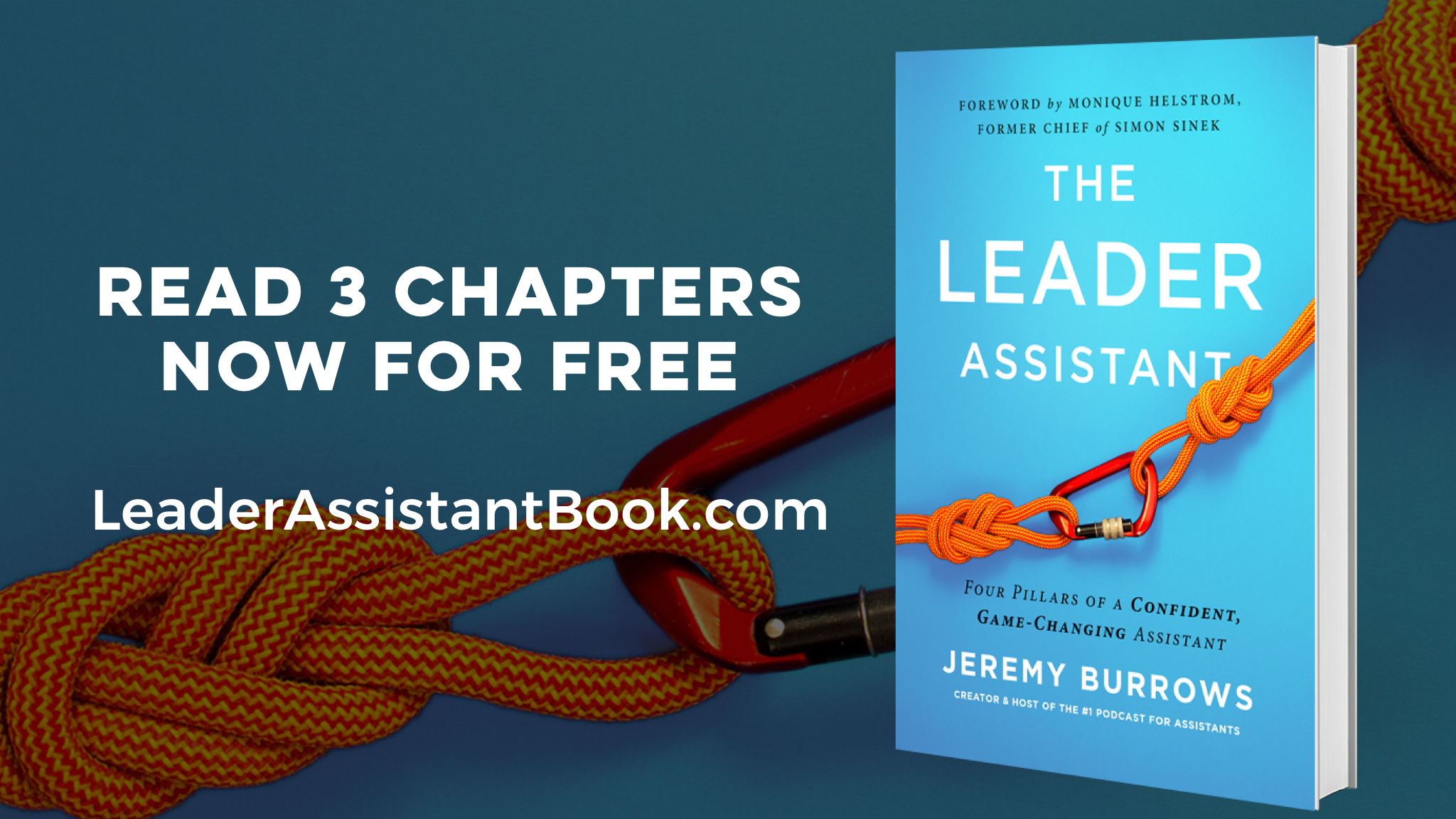
Download the first 3 chapters of The Leader Assistant: Four Pillars of Game-Changing Assistant for FREE here or buy it on Amazon and listen to the audiobook on Audible. Also, check out the companion study guide, The Leader Assistant Workbook, to dig deeper.
JOIN THE FREE COMMUNITY
Join the Leader Assistant Global Community for bonus content, job opportunities, and to network with other assistants who are committed to becoming leaders!
THE LEADER ASSISTANT PREMIUM MEMBERSHIP
To learn more about how you can join growth-minded Leader Assistants, check out our Leader Assistant Premium Membership for ongoing training, coaching, and community.
LEADER ASSISTANT LIVE EVENTS
Check out our constantly updated schedule of events for admins and assistants at LeaderAssistantLive.com.
SUBSCRIBE
Subscribe to The Leader Assistant Podcast so you don’t miss new episodes!
You can find the show on Apple Podcasts, Spotify, Google Podcasts, Pandora, and Stitcher.
Join my email list here if you want to get an email when a new episode goes live.
LEAVE A REVIEW
If you’re enjoying the podcast, please take 2 minutes to rate and review the show on Apple Podcasts here. Each review helps me stay motivated to keep the show going!
–––
EPISODE TRANSCRIPT
Jeremy: 00:21
Hey friends, welcome to The Leader Assistant Podcast. It’s your host, Jeremy Burrows, and this is episode 370. You can check out the show notes for this conversation at leaderassistant.com/370. Today I am excited to be speaking with Jana Franklin. Jana is the owner and president. CEO concierge is the business, is that right?
Jana: 00:54
CEO concierge, yes.
Jeremy: 00:56
CEO concierge, yep. And the uh it’s CEO concierge virtual assistant. It provides a wide range of services, including administrative support, scheduling, email management, social media assistance, etc. So we’ll hear a little bit more about that in a bit. But first, uh Jana, you are in the same state that I am in. Is that correct?
Jana: 01:20
Yeah. Yay! We’re in the show-me state, right? Let’s show well, we can’t show them today, but we’ll tell them, right?
Jeremy: 01:27
Exactly. Yeah. So Missouri, you’re in St. Louis, Missouri. I’m in Kansas City, Missouri. We’re probably about door to door. We’re probably about three hours and 30 minutes, depending on how fast uh you drive across uh Interstate 70.
Jana: 01:40
Oh, you can’t drive fast across Interstate 70 anymore, can you?
Jeremy: 01:44
Right, right. Um, so yeah, excited to have you on. Tell us uh what you love to do when you’re not working.
Jana: 01:53
Well, when it’s warm out, I like to be in my yard, uh, working in the garden, just sitting out enjoying this weather. Um I like to play mahjong um with my girlfriends. Um played that for quite a while. I know it’s becoming the older age of getting that right now, but I love mahjong. And then I have a freshman in college and a freshman in high school. So they keep me busy. My freshman in high school plays tennis and runs cross country. So um like to, you know, go support him. And then I’ve been married for 27 years. So yeah, uh lots of family and friend time if I can.
Jeremy: 02:36
Nice. So you have to tell me a little bit as a side note: is it mahang? Is that how you say it?
Jana: 02:42
Yeah, yeah.
Jeremy: 02:43
So I I noticed that I think my executive’s family is getting into it a little bit. I have no idea. I haven’t seen nobody I know is getting into it. I just saw something. I was like, what is this this game or something? So what is it? What’s like the TLDR there?
Jana: 02:59
Yeah, so it’s a Chinese tile game. Um, and it’s really supported. Um, it’s supported out of New York uh for the States. Uh, we they do a card, it’s the playing card. It is tiles. Um, I should know more about this. My mother could tell you all the rules and everything, but my mom taught me, she has taught a ton of people. She has taught me and my girlfriends here in St. Louis. So we we try and meet at least once a month to play. And it it it you can bet, we don’t bet in my group, but um, and it’s like quarters and nickels, right? And it’s almost it’s comparable. I hate like if you know pitch or euchre or you you it it’s there’s there are suits, but the suits are bams, cracks, and um oh my gosh, I just forgot the other one, bams, cracks, and uh dots. And and you you try and win your hand, right? And so, but it’s very um it’s addictive. You can play it online. Um, you have to pay for it online, but it’s addictive. And it’s I’m very competitive. Uh, but I love to see, I just I love to see people win Majon hands. You can, you can um, you know, it’s called if you if you don’t, if no one wins, it’s called the wall, you hit the wall. I mean, so it’s um it’s a four-person game, really, but you can play with three, you can play with five. Um, it’s really hard to play with less than three. Um, but it’s good. I have noticed people that are really good at math can catch on a lot faster than people who aren’t. Um, I think they see the board better. I don’t know why.
Jeremy: 04:44
But yeah, so you’re saying I would probably not be good at it because I’m not good at math.
Jana: 04:48
No, I mean I’m not good at math. I mean, I’m good at math, but I’m not good at math. It’s not my strong suit, right? So um I struggle at it sometimes. Whereas I have friends that can see the numbers and the boards faster. I don’t know.
Jeremy: 04:60
Nice.
Jana: 05:00
I don’t I don’t know. Cool.
Jeremy: 05:02
I’ll definitely definitely have I’m sure I’ll learn more about that soon if it’s if it’s uh getting popular too.
Jana: 05:08
So yes, yes.
Jeremy: 05:09
Um awesome. Well, tell us a little bit about your career, and uh then we’ll kind of get into you know what you’re doing now and and how we can we can talk about mistakes that CEOs make when hiring a virtual assistant, and then also um why every executive assistant should be treated like a business partner. So tell us about your your career journey and how you uh what what what your experience is and then how you ended up where you’re at today.
Jana: 05:36
I preface it with saying, learn from my costly mistakes. You know, learn like learn from me my costly mistakes so you don’t have to stick go through the costly issues. So I actually um my degree is in fashion merchandising. I am a former uh corporate uh handbag um buyer for small other goods for what was used to be May Department stores, which was Famous Bar, Lord and Taylor, um Hex, there were seven chains. Uh they were based in St. Louis, Missouri. And I severed out when Federated, Macy’s bought May Company in 2006, which was perfect. My my husband and I at the time were opening, getting ready to open our third Fantastic Sam’s franchise hair salon. And it was perfect because I was we were at the point where we thought we might want to start a family, like things were just changing in our lives. And so we so I so we opened another franchise, Fantastic Sam’s. We opened a total of five within five years, and then I had our first our first child. And then in 2010, a friend of my husband’s was talking to him about Jimmy John’s franchises, which was based in Champaign, Illinois at the time, and how much money these Jimmy Johns made, and this is so great, and so forth. So we went over to Champaign and we drank the Kool-Aid and we bought into the franchise in 2010. We opened our first store in 2011 when I was seven and a half months pregnant with our seconds, and proceeded to open a total of six within the next five years and about died. A lot of growth. Um just, you know, like I said, learn from my expensive mistakes. Um and then in 2017, really came to a uh uh mental, emotional, everything halt. Uh told my husband he needed to come in and run the companies and I needed to take a break. And so did, and then I came back in right before COVID, big mistake. And it and then uh realized at that point, like I am not good at everything, even though I want to be, you know, I want um, I’m not good at everything, nor do I want to be good at everything. And I want to spend my time where I like to be. And so COVID hit about the same time. And and that’s when I realized, okay, I need to be in my stores. And everything else that I was doing that I wasn’t really good at, I needed to bring in someone to help me. And so that’s when I brought in a virtual assistant to really work on the things that I was not good at. And that way I was allowed to be in to in the stores where I actually did better, right? My business grew during COVID. It did, you know, I a lot of people can’t say that. Now, I say that Jimmy Johns grew during COVID. The hair salons got shut down because they were not considered essential. And so I had two big dichotomies going on where one was like, you know, going gangbusters, and the other one was like, my people were unemployed. So it was just a very emotional, but at the same time, that’s when we brought in the virtual assistants as well and to help me and the Jimmy Johns companies. And so it just it just really has transpired. Um I have really realized, and I also turned 50 in there. So I think I also was like, I don’t spend time anymore doing things that I’m not good at, nor do not benefit my company, myself, my family, my friends. Like it, I have to be being productive as a person of society. And so that for me is kind of where I’m at today. Um, is like what can I do to grow our companies, grow me as a person, be supportive as a parent, and so forth. And so that’s really where this, the the invention of CEO concierge came into play. Because in talking to my friends who are also business and entrepreneurs, they were like, Jana, you’ve got something here figured out on the VAs, on the virtual assistants that you really need to bring out to other entrepreneurs, especially women. And that’s where that really kind of play came into play because I think, and I’ve noticed this more after being in CEO concierge for two years, is that women are very relationship driven and men are more tactical. But the other thing was is I think because, and I’m not saying all of us, but we’re running our households, we’re running our companies, we’re running ourselves, we’re overwhelmed, but we’re also want to be perfectionist. And so that’s where I think a lot of the control and overwhelmness comes from. And so I really playing into that, at least with the female entrepreneurs, to really understand like you don’t have to do it all. And this is why.
Jeremy: 10:52
Yeah, that makes sense. Awesome. So what is so you you started CEO concierge, you have a like a team of of uh contractors essentially that that you provide, or how does that work?
Jana: 11:05
Well, we became a Philippines entity in May of 24. So all my employees in the Philippines are all my staff in the Philippines are part of the entity. They are employees. So we are able, because this was very important to me to be able to give them benefits. And and 82% of my staff in the Philippines are female, and a lot of them are mothers. And so I really wanted to make sure that they felt that, well, all of them, that they had my support and the and the growth and the professional development that they need and want as well. And so that’s why we did go in and establish as employees.
Jeremy: 11:50
Nice, nice. So what is the, you know, I asked, I asked all my guests what topics they’d like to discuss, you know, before diving in. And one thing that you provided I thought was pretty interesting. Uh you said the $100,000 mistake that most CEOs make when hiring their first virtual assistant. And so what talk through that that big mistake that’s that most CEOs make.
Jana: 12:16
I think, well, let me rephrase that. I know.
Jana: 12:23
We there’s this thought process that a virtual assistant is going to come in and be able to take over and help that person from ground from from day one, knowing everything they should know. And and no one no one brings in an employee that way, right? Like, if I was to bring in, you know, uh a manager in my restaurants, I’ve got to train them. Like they don’t know everything, they don’t know my core values, our, you know, as a company, they don’t so on and so forth. And I think there’s this misconception that this, oh, I hired this virtual assistant. They’re gonna know how I want my emails responded to, and they’re gonna know that that they that you know, Susie has to be, she’s always out of the office by three o’clock. You know, they they just they know this. And so they get so there’s this level of frustration that comes over from the CEO and the or the client that they don’t know what they’re doing. And it’s not that they don’t know what they’re doing, it’s that no one has taken one hour, 30 minutes. We do, we do an onboarding call with them, but there has to be an understanding that they’re not gonna know how you want a certain email responded to, or that you know, you have to set some guidelines, just like you do for anyone else in your company, and expectations and and and and that open communication. And I think that is where the biggest mistake comes in and the frustration comes in, because they don’t they the expectation is that these people are gonna know what they’re doing. And yes, they do know what they’re doing, they don’t know what they’re doing for that particular client as far as how they want interaction to happen or how they want to be, how they want communication and to be done. And that’s where it gets costly because what happens is they are piecemealing it out and it’s not working. And so I really this is where I come in with a lot of our clients and say, okay, this, you know, when we’re doing the discovery call with them, and then when we’re doing the onboarding call with them, where we are I’m very clear. We are very clear to them and say, look, it is going to be a walk. There is going to be daily communications for the first couple weeks. You are going to feel that you don’t have control over the situation. You are like, I’m trying to make them feel like trying to make them understand like this is not something that is going to happen overnight, but it is going to happen very quickly, but you also have to put in the time. And I think that’s where the misnomer comes into play. And so I always have to say, Well, you do do this with any of your other employees. And then I’m like, Well, if I have a turnover issue, I know why. So, because it gets costly. They get frustrated, it the CEOs get frustrated, and there’s no reason, there’s no reason why, really.
Jeremy: 15:41
Yeah. Um what’s the what’s the what’s something you’ve learned as you’ve onboarded these assistants to to CEOs and executives? What’s maybe the top onboarding tip? Like what’s, you know, you mentioned like, oh, you’re gonna have a touch point every day for two weeks. That’s a good good practical thing, but like what’s another practical, like, hey, I’m starting with a new executive, or hey, I’m gonna hire an assistant, what do I need to do in the first 30 days?
Jana: 16:06
Well, I think first and foremost is uh to let the virtual assistant know, and and this and this applies to executive assistants in person, personal is like for me if I’m hiring an executive assistant, virtual assistant, to me, that is that is so encompassing of task, right? And so I am very clear with my virtual assistants that the task could change, expectations could change, uh, priorities definitely change on a daily basis in my business. And so are they okay with that? Are they is there gonna be any frustration, you know, please understand there’s frustration. But here’s the thing you have to ask me clarifying questions. You have to ask me clarifying questions when you have me. Because if you don’t, I’m assuming you know what you’re doing. And then if you don’t, and you come back three days later and ask me a clarifying question of something we just went through, I’m gonna be very frustrated.
Jana: 17:15
Right.
Jana: 17:16
And so we’re really, but the other thing we focus on also when CEO concierge is we do personality assessments and we are really, and I think this is also key because this is this is key in any business, right? You get along, you are going to collaborate better with someone that is complimenting you, not complimenting your work, right? So, like for me, I really need someone that’s gonna be detailed oriented because I’m not. So we could be we could be collaborating on a Zoom call, but I’m not really taking notes. They’re the ones taking notes. So we are making sure that we are matching personalities up. So I’m very autonomous. I need someone that’s autonomous, but not to my level. I need someone that’s detailed, I need someone that’s a sense of urgency, but it’s patient. So I am so we’re using those personality assessments, which is I I call it our cheat sheet, right? Because we’re making sure, because I I mean I don’t know about you, but I work with people that I don’t like, I don’t jive with, I don’t work well with, and we don’t we don’t produce to the level that I would if I’m working with someone that I can work well with, if that makes sense.
Jeremy: 18:34
Yeah, totally. So what’s your what are some of your favorite, or do you have like what just one main personality test that you case?
Jana: 18:41
So we use culture index.
Jeremy: 18:43
Okay.
Jana: 18:44
Um, we use culture index. We has off we have also used 16 personalities. Um we have used that, um, but we really utilize culture index. And the other thing I think that’s important is especially when you’re dealing with the CEO of a company, a C-suite, a lot of people are touching those people. And so I think it’s very important that everyone that the assistant is dealing with is taken into account because you could be reporting to the CEO, but say the CEO is growing, the business is growing and they’ve added a director level in between them. Well, they need to make sure that who’s ever reporting now to the director is gonna get along with is gonna jive with the director. Because if they’re not, then then the personality becomes a complete the production, the productivity, everything becomes an issue because the they’re just not clicking. And so that is one of the things that we really drive in. I mean, I have we have clients that have multiple partners, right? There’s three founders. We’re doing the personality assessment on all three of them. We’re not doing it on the one. And I think that because when you’re interviewing someone in person, you kind of get the body language and you get their you get all you get that feeling, right? You get a gut feeling like, oh, I really like this person. I don’t know. And so I think sometimes when you’re dealing with virtual, whether it’s work from home companies, you know, I think there’s a lot of companies doing, you know, come back to work, come back to the office right now. I think you lose a lot of that. And so this is just another step to make sure it happens.
Jeremy: 20:34
Awesome. Um what about the idea of, we talk a lot about this in the in the assistant world, this idea of being a business partner or a strategic business partner. Um and you know, you’re obviously working with the executives and trying to encourage them and and uh encourage them to treat their assistant as a business partner. Tell us a little bit about how you how you maybe present that business case to these executives, how you help the assistants uh you know own that and lean into that and see themselves as as strategic partners.
Jana: 21:14
I think it’s very important. I think getting your ideas brainstorm uh how different getting outside the box. I think uh for me, with my virtual assistants, they have ideas that I would have never thought about because they see, they’re seeing in like in our database system, we use Trello, right? They’re seeing their bookkeeping in my books, in my invoices, they’re seeing our emails, they’re seeing the calendar, they’re seeing maybe efficiencies that could be fixed, they’re seeing uh an idea that we’re struggling with that maybe they have an idea that you know what, but no one’s asking them. So we really, so that’s where I’m like, I’m always, if I’m on a call, I’m always saying, Well, what do you think? Well, what do you think? And sometimes they’re kind of when it first happens, they’re taken back. They’re like, What what do you mean? What do I think about this idea? Like, this is your company, right? And I’m like, no, but you’re engaged, you’re seeing stuff, you probably have an idea. Number one. Number two, you know what? They talk to each other in our company, the virtual assistants. There might be something going on in a company, or I might see something. Um, and I have a firsthand to it, but I might see like something that might be working at a company, and yeah, we’re gonna talk to that client, be like, hey, this is awesome. Do you do you have any qualms? Do you have any confidentiality? Do you do you mind if we share this? Because this might work over there. Like it’s not a competition, whatever, whatever. I’ll use an example. I have a client who had this recruiting process that was dynamite. And I, as for the Jimmy John side of it, was like, we need to do this, right? And so we went to the client and I said, I don’t know what you’re doing, but can I talk to your VA? Can my VA and your VA talk and figure out if this is something I could institute over here? And she was like, sure, no problem, right? She’s in Vegas and I’m over in St. Louis, and there’s no competition. And so they did. And then they got they got it figured out and they presented it to me and we launched it. And let me tell you, it made a huge difference. And but I didn’t have to do anything. And I mean, so there’s so they’re bringing stuff together that they’re seeing and hearing from other things that cut down on help with my efficiencies and help with my profitability. And so I think that’s where I say bringing bringing them in as a partner is is making sure that you’re including them because I think that they see things that you’re you’re not thinking of because you’re in the well, right? You’re in the you’re in the trenches.
Jeremy: 24:08
Yeah. So I love that too, because you know, those listening either are part of a uh assistant team at their company, or they’re not like me. They might be the only assistant in their company, but you know, that’s why I have the leader assistant community, leader assistant resources, so that they can reach out and connect with other assistants because part of being a uh, like you mentioned, a business partner is hey, you know what? I am aware of what’s going on in in this industry. I’m aware of what other assistants are doing with their executives and with their teams, and I’m gonna go learn and network and and grow from that interaction with with uh with peers. And so just being able to put yourself out there and connect with other people and and be willing willing and open to hear how are you being treated like a business partner and how are you helping your executive see you as a business partner? Um, is that’s great, super helpful.
Jana: 25:07
Yeah. I mean, the productivity, you know, you got to be proactive, right? The other thing I think it’s really it’s really interesting. Um, it didn’t even phase me. So um uh my sales team and I were on a training on Friday, a long training on Friday, and it was phenomenal. And we we already had our call and recapped and said, okay, what are our takeaways from it? Whatever, and all of us talked. And the virtual uh salesperson that was on the call sent me an email and she’s like, Hey, is there any certifications that came out of that training? Because I would love to be able to include that. She didn’t say resume, because I was like, leave it me. But um the professional development too, the upskilling of an assistant, like they want to continue. You I want to support my assistants to continue to grow professionally, personally, and professionally. And so if there’s the ability for them to attain, there’s so much free AI training right now. Like if you talk about AI, right? If there’s so much free AI training, why wouldn’t you? I mean, like I’m constantly saying those to my virtual assistants, like, hey, this might be something that you could really benefit from. Yeah, right. And so I think that is also key. And that’s part of like treating them as a business partner. You you’re gonna send your employees to training, why wouldn’t you send your assistant to training?
Jeremy: 26:35
Yeah, totally. And you know, why wouldn’t you send your assistant to leader assistant training course? You know, there’s a free podcast that you can listen to, you know, all the things. No, but yeah, that’s awesome. Janna, thank you so much for sharing. And I I love uh I love catching up with folks, especially in my state, uh, my home state. Um but yeah, hopefully we’ll run into each other sometime in uh Kansas City or St. Louis. But what’s uh what’s the best place for people to reach out if they want to learn more and find out more about you?
Jana: 27:10
CEOconcierge.com is how to reach me.
Jeremy: 27:24
Awesome, awesome. Well, I will put those links in the show notes at leaderassistant.com/370. Uh you can reach out and say hi to Jana. Um, but yeah, I appreciate your time. Uh thanks so much. Good luck with your business and uh appreciate uh yeah you being on the show.
Jana: 27:41
Thank you, Jeremy.