Annie Croner is the founder and CEO of Whole Assistant, an online platform & community, formed to provide a positive place where assistants can go to transform their lives and level up their careers.
In this spotlight episode of Annie’s show, The Whole Assistant Podcast, she talks about overcomplexifying.
CONNECT WITH ANNIE
- Annie on LinkedIn
- Whole Assistant Website
- The Whole Assistant Podcast
- Email: annie@wholeassistant.com
- Whole Assistant Instagram

ABOUT ANNIE
Annie Croner is an executive assistant coach, trainer, and strategic thinker. She loves to help her clients unlock their badassery, and revolutionize their careers.
Over her 20 year career as an executive assistant, Annie worked for boutique companies across multiple industries including accounting, marketing, nonprofit, and private wealth management. Working in a variety of settings has led to a diverse understanding of the assistant role and the many challenges that often come with it.
Annie is passionate about helping those in support roles show up more strategically and garner the respect of their executives, colleagues, and key stakeholders without sacrificing their mental health and well-being.
Annie lives in Denver, Colorado where she enjoys green smoothies, her family, and an occasional evening of Latin dancing. To learn more about Annie, please visit WholeAssistant.com.
–––
THE LEADER ASSISTANT PREMIUM MEMBERSHIP
To learn more about how you can join growth-minded Leader Assistants, check out our Leader Assistant Premium Membership for ongoing training, coaching, and community.
THE LEADER ASSISTANT BOOK
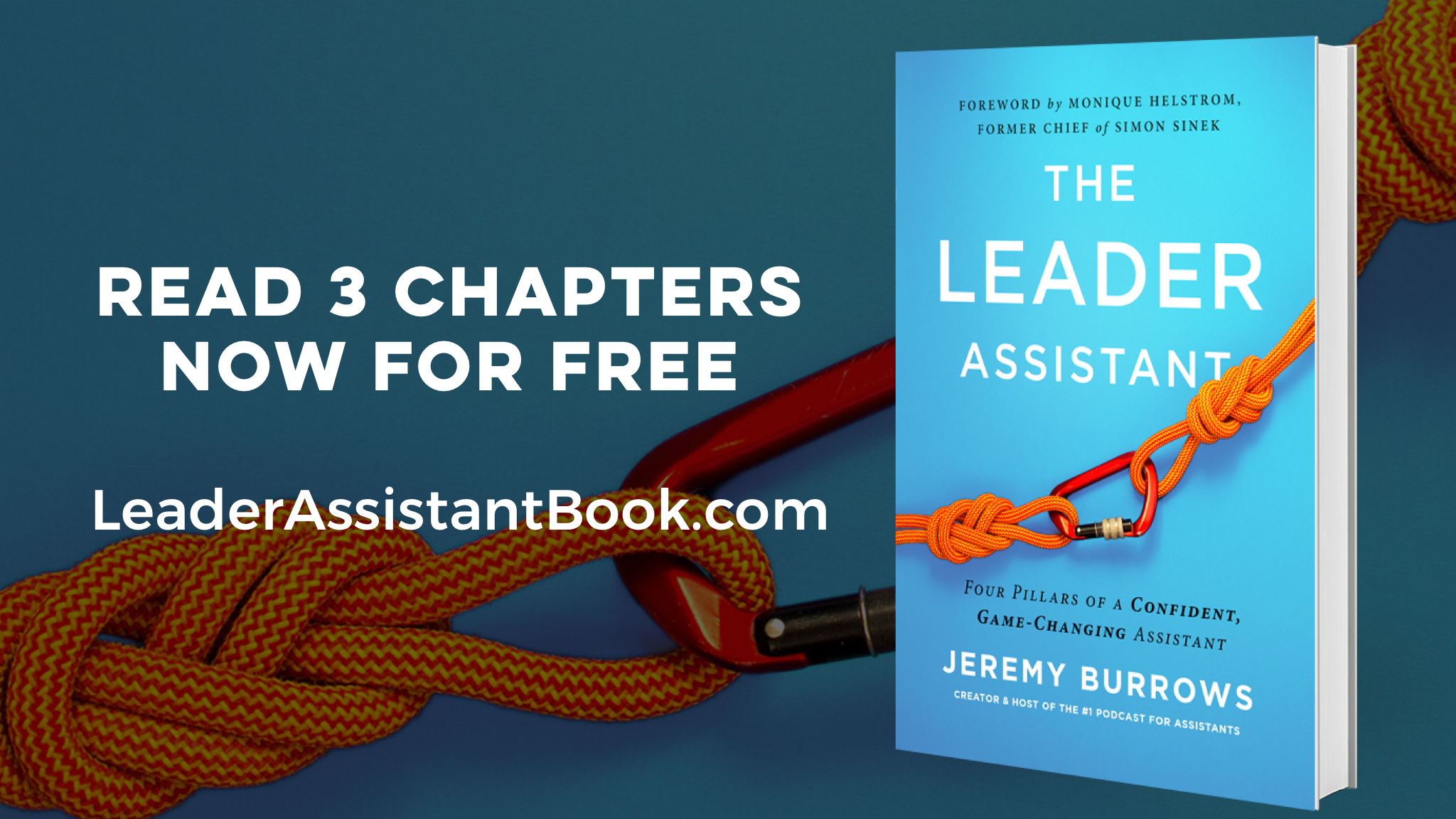
Download the first 3 chapters of The Leader Assistant: Four Pillars of Game-Changing Assistant for FREE here or buy it on Amazon and listen to the audiobook on Audible. Also, check out the companion study guide, The Leader Assistant Workbook, to dig deeper.
LEADER ASSISTANT LIVE EVENTS
Check out our constantly updated schedule of events for admins and assistants at LeaderAssistantLive.com.
JOIN THE FREE COMMUNITY
Join the Leader Assistant Global Community for bonus content, job opportunities, and to network with other assistants who are committed to becoming leaders!
SUBSCRIBE
Subscribe to The Leader Assistant Podcast so you don’t miss new episodes!
You can find the show on Apple Podcasts, Spotify, Google Podcasts, Pandora, and Stitcher.
Join my email list here if you want to get an email when a new episode goes live.
LEAVE A REVIEW
If you’re enjoying the podcast, please take 2 minutes to rate and review the show on Apple Podcasts here. Each review helps me stay motivated to keep the show going!
—
EPISODE TRANSCRIPT
Jeremy Burrows 0:00
Hey, friends, it’s Jeremy Burrows, host of The Leader Assistant Podcast. Thanks for tuning in. Today, I’m excited to highlight an episode from my friend Annie Croner’s podcast called Whole Assistant. And I really think you should check out her show at wholeassistant.com or look it up on your favorite podcast platform. Again, Annie Croner podcast called Whole Assistant today, I am spotlighting one of Annie’s episodes from the whole assistant podcast, and I’m excited to spotlight several episodes over the coming months. So I hope you enjoy it, and I hope you check out wholeassistant.com to learn more about Annie and her great podcast,
Annie Croner 1:04
Welcome to another episode of the whole assistant podcast. So we’re just going to launch in here today. We are talking about over complexifying so by show of hands. How many of you ever have found that you make things harder than they have to be? I know I know I just said show of hands, and you’re literally listening, probably on your car, right into the office, but I do think that we often make things harder than they have to be, and that’s what over complexifying really is making things harder or more complex than they need to be. And honestly, over complexification is rooted in perfectionism, and it’s also our brain’s way of trying to not take action and not take action due to perfectionism, due to fear, due to like, fear of messing up or making a mistake. And here are some examples of over complexification, wasting time wordsmithing an email that should have taken two minutes to create. How many of you guys have ever done that? I know I have done that a time or two in the past too, where I was kind of nervous to send an email and I really did not want to sound dumb, and so I would take so much time to wordsmith Annie mail that literally shouldn’t take me two minutes to create, especially early on in my career. Another example is taking passive action instead of massive action. So passive action is like learning, like doing all the studying, doing all the research, and if we feel really accomplished at the end of that, but unless we’re actually implementing what we learn or taking massive action, that passive action becomes pretty pointless, and more often than not, our brain’s way of over complexifying thing is to do endless research. So that’s what our brain wants to do. I’d rather spend time spinning out in all the research and exploring all the options than actually making a decision that will move you forward. Any decision is better than getting stuck in endless research. Another example is convincing yourself that you’re missing pieces of the puzzle. It’s like I must be missing something here. I wonder what it is. And so we turn to our communities, we ask the questions, and then what generally happens is we get conflicting pieces of advice back, right? I don’t know if any of you have ever experienced that, but I’m a member of several online communities geared towards executive geared towards executive assistants, and I see this all the time, because everyone has their different vantage point. And honestly, our brains desire to look for the one right way, like that thing that will that will make it all click, is a way of over complexifying. And then, of course, anything else avoidant, anything that you do to avoid doing the actual thing itself that is making your work more complicated or complex, that is over complexifying. So how do we stop over complexifying? I think first of all, it’s really a good idea to be onto yourself. If this is your pattern, if you see that you do this on a consistent basis, pay attention and get curious in those moments. It’s like, what am I actually avoiding here? Just take a pause, get curious. And I like to use the sentence, I see you brain, I see what you’re doing. I get it. I know that we’re scared to take this action, but it doesn’t mean that we can’t. So now we’re going to take an action. Any action is better than being stuck in inaction. So we are going to take the action and also be there for ourselves, because our brain is totally freaking out. I think also, a lot of us struggle with perfectionism, and in order to stop complexifying, a lot of us need to just kind of release the perfectionism. A lot of us believe that there’s one right way, and most of us are convinced that we don’t know what that one right way is, but honestly, there is no such thing as perfect. Perfect is such a moving target, and so I really want us to pay attention to our brains whenever we think that there’s like this one right way that will that you don’t know about. Out, or there’s this one right way, and you weren’t sure what it is, and then we go down like this, over complexification, like tunnel, and we just get really, really obsessive. It’s not serving us. It’s certainly not serving our time management, and it’s not moving us or the business or our executives forward. Instead, I want us to aim for excellence and release the perfectionism. I love the definition of excellence. It is the quality of being outstanding or extremely good. The quality of being outstanding or extremely good. I love that definition because there’s no perfection in it at all. You can be extremely good without having to be perfect all the time. The next thing to stop over complexification is just to take the next step. And often we know what the next step is, and we don’t take it because we want to know all the steps up front. And often what happens is that when we take that next step, we often know the next step to take from there, like you take the step, and then you look around and you assess your options, and then you’ll take the next step. But what happens is we want to have this outline plan from the beginning, and oftentimes that’s not how life actually works. Oftentimes that’s not actually how our roles work. I love this too, because this will also keep us out of overwhelm. If we’re only focused on the next one thing, then we become a lot less overwhelmed, because we aren’t trained to take it all in, right? And that over complexification feeds into our overwhelm. So I just want us to pay attention to that, and I just want us to take the next step that will help us achieve the end goal. And also, I want you to ask yourself this one question, what is the simplest and most logical solution. Often it’s sitting right there in front of us. It’s just that our brains don’t want us to take the action. So instead of taking the action, we spin out on all these other things and we over complexify. And that is what is holding us back from strategic time management and then also from being the most effective in our roles that we can be and look, you can always pivot later. If your executive gives you feedback and other people give you feedback, or you notice that something isn’t quite optimal, you can always pivot later. But actually taking the step will create a good benchmark, a good baseline for you moving forward. Here are some other helpful thoughts, as we talk about over complexification, Done is better than perfect. Yes, yes, it is all day, every day. Thank you. Good night. Done is always, always, always better than perfect. And my coach always used to say b minus work could change the world. I know for a lot of us that we strive for a plus plus plus work, so I’m gonna encourage you to strive for B plus work, and I’m just gonna say that b plus work can change the world, and I know this to be true in my own life. And as I started whole assistant, I was just noticing that I would occasionally put a post out there that would have a typo in it or something, and someone would call me out on it, and oftentimes I get judged for that, right? But look, I put myself out there, and I also learn from that mistake, and now most of my posts are B plus work or a minus work. It’s not like where you are is where you will always be either you will grow and continue to evolve and continue to change, but B plus work can change the world, and honestly, until you put that B plus work out there, you will not improve, because there will be no real impetus to and you’re not actually receiving feedback from anyone. And here’s another thought that I really want us all to consider, thinking this is just my brain’s way of trying to protect me, bringing it back to my first point, which is, I see you brain. I get it. This is just you trying to protect me. And thank you. Thank you for trying to protect me. And we got a light at fire, because this whole over complexification thing is not working out so well for us. Okay, especially if you really want to embrace your badassery and level up as your strategic business partner. We have got to release perfectionism and we’ve got to release over complexifying things. Okay, guys, that is what I have for you guys today. Be intentional, be whole. That is all for now.