

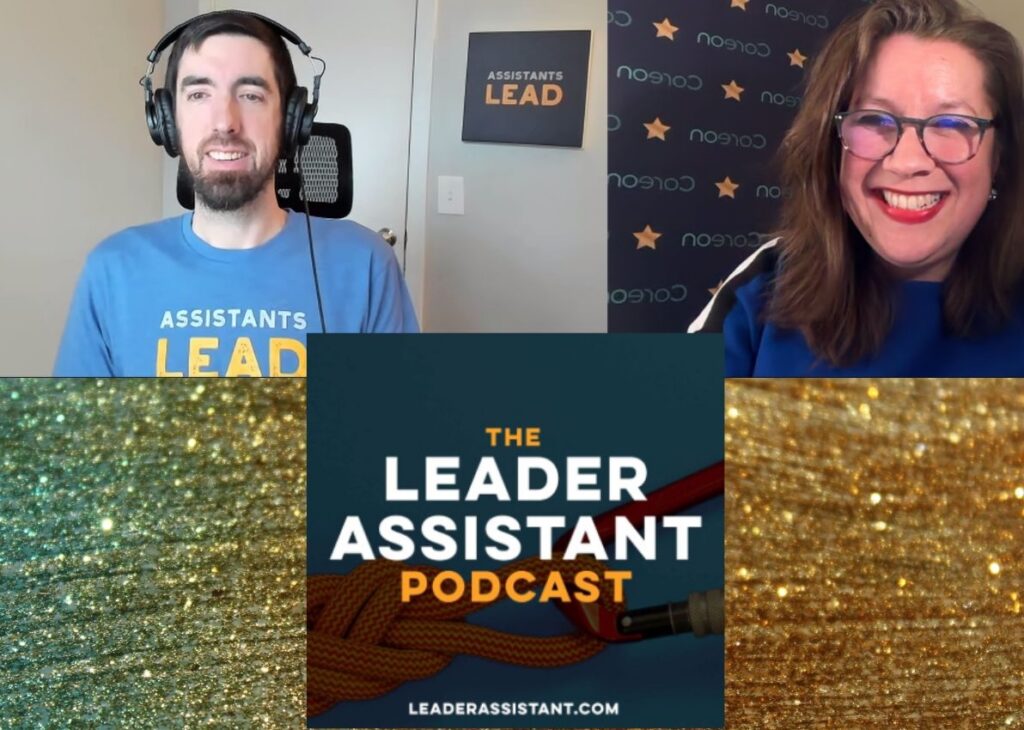
I had the honor of speaking with Maaike Knoester for an interview on the 5 Star Assistant Podcast to discuss my 20-year career as an Executive Assistant, my book The Leader Assistant, and the journey of producing over 360 episodes of my own podcast.
In this conversation we talk about challenging misconceptions about our profession. The greatest misunderstanding is that EAs are merely “one-trick ponies” focused on scheduling and expenses. In reality, we are strategic partners who see the whole picture for our executives. Internally, the biggest barrier I see is a lack of confidence, often stemming from attaching personal worth to job performance.
To combat burnout and build a sustainable career, I emphasize two core principles:
- Detach your worth from your work. Your value as a person is separate from your job performance.
- Set clear boundaries. I made it a point with my current executive to log off on the weekends because you cannot truly help others long-term if you don’t take care of yourself.
Finally, when it comes to being busy, I see “multitasking” not as doing two things at once, but as the critical skill of prioritizing and context switching effectively between diverse responsibilities.
Thank you, Maaike, for the opportunity to be on your show, and for asking such great questions!
CONNECT WITH MAAIKE

ABOUT MAAIKE KNOESTER
With over 20 years of experience as a trainer and coach, Maaike Knoester helps support professionals own their 5-Star Value and raise their profile. Not by working even harder, but by taking their place with powerful personal leadership. True 5-Star Assistants are instantly recognizable. Not only by the way they perform their work—with precision, strength, and impact—but especially by how they see themselves: as an indispensable force in the organization.
–––
THE LEADER ASSISTANT ACADEMY
Enroll in the on-demand, AI-powered professional development resource for Leader Assistants who want to level up. Learn more -> The Leader Assistant Academy.
THE LEADER ASSISTANT BOOK
Download the first 3 chapters of The Leader Assistant: Four Pillars of Game-Changing Assistant for FREE here or buy it on Amazon and listen to the audiobook on Audible. Also, check out the companion study guide, The Leader Assistant Workbook, to dig deeper.
JOIN THE FREE COMMUNITY
Join the Leader Assistant Global Community for bonus content, job opportunities, and to network with other assistants who are committed to becoming leaders!
THE LEADER ASSISTANT PREMIUM MEMBERSHIP
To learn more about how you can join growth-minded Leader Assistants, check out our Leader Assistant Premium Membership for ongoing training, coaching, and community.
LEADER ASSISTANT LIVE EVENTS
Check out our constantly updated schedule of events for admins and assistants at LeaderAssistantLive.com.
SUBSCRIBE
Subscribe to The Leader Assistant Podcast so you don’t miss new episodes!
You can find the show on Apple Podcasts, Spotify, Google Podcasts, Pandora, and Stitcher.
Join my email list here if you want to get an email when a new episode goes live.
LEAVE A REVIEW
If you’re enjoying the podcast, please take 2 minutes to rate and review the show on Apple Podcasts here. Each review helps me stay motivated to keep the show going!
–––
EPISODE TRANSCRIPT
Intro: 00:06
The Leader Assistant Podcast exists to encourage and challenge assistants to become confident, game-changing leader assistants.
Maaike: 00:19
Welcome to the Five Star Assistant Podcast, and this is in English for my Dutch listeners. This isn’t English now, because I have a special guest, very special, from the US, and it’s Jeremy Burroughs. Jeremy, welcome to the show.
Jeremy: 00:38
Hey, thank you so much for having me. I’m excited to be here.
Maaike: 00:41
Yeah, so am I, because when I started the podcast, the Five Star Assistant Podcast, I was looking for examples and I saw the Leader Assistant Podcast showing up as the only one at that time. That was 2019. So to me, you’re a great example of using your voice for assistance. So thank you so much for inspiring me to do the same thing here in uh in Holland and Belgium.
Jeremy: 01:11
Yeah, you’re welcome, and I’m glad that uh I’m glad to be speaking with another podcast host for sure.
Maaike: 01:17
Yeah. Yeah, so let me introduce you a little bit, and then of course you can introduce yourself furthermore. Um you are an executive assistant, like senior executive assistant, so for a long time now, you also um wrote a book, not only the podcast, but you also wrote the book The Leader Assistant Pot uh The Leader Assistant, where you use also the four pillars um as an important piece of yeah, I would say like to become a five-star assistant, maybe that’s that’s uh a bit familiar. And you’ve done um, I think 360 episodes, so that’s quite impressive.
Jeremy: 02:02
Thank you. Yeah, it’s been a lot, it’s been a lot, but it’s been fun. Yeah, I’m currently senior executive assistant to the CEO of a software company based out of St. Louis, Missouri. We have over 400 employees all over the world. Our company’s called Capacity. Uh, we’re in the AI-powered support automation software platform uh industry, and so I was hired number one. We started in January 2017 and uh yeah, been there ever since, and it’s been a fun ride, and I love being an assistant, and I think this is my 20th year as an executive assistant.
Maaike: 02:38
Cool. So, yeah, I always ask my guests at first what their guilty pleasure is. So can you reveal what it is to you?
Jeremy: 02:50
Oh, you know, I’d probably say uh there’s a couple treats that I really like to eat that are super unhealthy and probably full of chemicals. Uh, I don’t know if they probably don’t even have these um in your country, but they’re called uh I think they’re from Hostess and they’re called zingers. They’re like chocolate, they’re almost like Twinkie, chocolate Twinkies with chocolate icing and and you know white cream filling. Um but that’s kind of one of those things where it’s very unhealthy, but every once in a while I’ll swing by the gas station and pick up a pack because I really like them.
Maaike: 03:29
Yeah, and it gives you a little joy at the moment, so makes you and then and then and then maybe a little bit of regret afterwards. But oh yeah, yeah, that was that that’s why it’s guilty pleasure, of course. Yeah, great. And can you tell me a little bit more where you live, with whom?
Jeremy: 03:46
And yeah, so I live in Kansas City, Missouri, right in the middle of the United States. I was uh raised here. I was actually born in Virginia, but I moved to Kansas City when I was one, and so I’ve been here most of my life. I did live in uh St. Louis for about 16 years, uh, met my wife there, had our kids there. We have two boys, um, and then we moved back here during COVID in 2020. And so my uh let’s see, my boys are 12 and 14.
Maaike: 04:20
Okay.
Jeremy: 04:21
And they’re in soccer, um, baseball. My oldest plays violin. Um, so yeah, it’s uh it’s fun, fun ages and uh fun time, me and a dad for sure.
Maaike: 04:36
Nice. And and baseball is also one of your um big passion, right?
Jeremy: 04:44
Yeah, I love baseball. Uh, I played a little bit when I was a kid, and I love going to baseball games and taking my son to baseball, and um, yeah, it’s fun uh fun times for sure.
Maaike: 04:57
Yeah, so yeah, I’m very um curious, of course, what in March 2019 you launched the Leader Assistant Podcast. Um, what made you decide to start the podcast?
Jeremy: 05:13
Yeah, I would uh I would say I’ve I’ve always had kind of an audio production background and interest in it. And when I had my prior role, I had done some audio editing, some podcast work. So, and then I did some music, I was into music a lot. So when I was doing, when I started off as assistant training and coaching, speaking for executive assistants all over the world, I thought, you know, maybe someday I’ll do a podcast. Well, I didn’t want to start one until I was ready and had enough content that I felt like I could actually keep going. Because when I first launched, there were not very many podcasts out there for assistants. Uh, and the few that were out there um were not updated or hadn’t been updated in a long time. And so I figured if I could, one, I like the medium and I enjoy audio production. I enjoy doing the editing myself and deciding what to cut or what.
Maaike: 06:15
You like the technical stuff.
Jeremy: 06:17
Yeah, I like the technical stuff.
Maaike: 06:19
Yeah.
Jeremy: 06:19
Um, but two, I obviously, you know, I like the medium of podcasting as far as reaching people all over the world and helping people all over the world. Yeah. But again, I wanted to do it really well. I didn’t want to um kind of go in with you know one foot one toe in. I wanted to go all in. And so in 2019, I had enough blogs written, I had enough of a network, I had enough, I had more experience, and I thought, you know what, I’ll just see if I can schedule out, you know six months or a year worth of podcast content. Oh, yeah. And if I could, if I could, then I would go ahead and start the podcast. So I started mapping it out, and I was like, I think I have enough content to produce a weekly episode. Yeah. And so fast forward uh so March 2019, and then uh now we’re in 2026, and I’ve published over 360 episodes. I’ve only missed two weeks. There, there’s two holidays in 2019, I think.
Maaike: 07:20
That is so good, like it’s so consistent.
Jeremy: 07:24
Yeah, it’s been a lot, it’s been a lot, but I’m proud to say that I’ve kept it up and I crossed over a million downloads in early 2025, and that was my goal when I set out to get to a million downloads.
Maaike: 07:36
Okay, congratulations on that.
Jeremy: 07:38
Thank you.
Maaike: 07:38
I guess my goal is two million now, but yeah, raised your goals.
Jeremy: 07:43
So yeah, so that’s kind of why I uh I kicked off and and have have been going ever since.
Maaike: 07:49
Yeah, yeah, and and I read uh on your website and I think in your book as well, that you are you see yourself as a as an introvert. So that raised the question to me from okay, so what what helped you to choose for visibility? Because with yeah, with speaking for public, with your podcast, you are uh you are yeah, not only behind the scenes, but right in front.
Jeremy: 08:20
Yeah, yeah. I mean, it’s one of those things where I’m an introvert, but if I prepare and plan, then I can present, I I speak, I do training, um, I enjoy that element and helping people in that way. Um, I just have to prepare a lot. And so it’s a lot easier. It’s kind of sounds a little uh a little outside the box, but for a high introvert like me, I would rather go on stage in front of a thousand people and present a keynote than then go to a party with 25 people and try to make small talk.
Maaike: 09:02
Yeah, yeah, yeah, yeah. Yeah. Because does it have to do with your expertise that it’s like you can really share like yeah the content?
Jeremy: 09:14
Yeah, it’s it’s partly that. And then it’s just like when you’re in a uh social setting, there’s a lot of small talk, which I don’t enjoy small talk. Um, I like to skip that part and get into deep conversations about interesting topics. Um and I also I also just enjoy like preparing and and coming up with my my bullets and my slides and my stories and just kind of integrating everything together into a story arc and and so yeah, I think it’s a little eas a little easier to do that when you have time to prepare and present to people.
Maaike: 09:53
So yeah, exactly. A lot of preparation. So okay. What do you believe is the one thing most people misunderstand about being an executive assistant?
Jeremy: 10:08
Oh, that’s a tough question. Um I would say most people, executives, professionals uh in the corporate world don’t understand the weight that executive assistants carry. Um, when it comes to discretion and confidentiality, when it comes to seeing all sides of the elephant, if you will, there’s that old analogy, it’s like, oh, I I think this is a giraffe, or I think this is a whatever, and then you turn the light on and it’s an elephant, elephant, because only people can only see the one part of that they see. And I think assistants, assistants can see the whole picture more often than others, and I think people don’t understand that. People think that we are one-trick ponies, and that we do scheduling, uh, travel and expenses and other duties as assigned, and they don’t see that we are actually strategic in our perspective and strategic in our action right.
Maaike: 11:25
Yeah, there’s a lot more to it. Yeah. Yeah. And and that’s the thing also um w what what do you see on the other side with assistants that they might not accelerate or might not live to their full potential? Because you talk about the leader assistant, so that’s not someone who is only um oh I I don’t know the word in English now. It’s not one who only does what’s being told, but she’s a leader or he’s a leader. And so what did you see with assistants that they hold back or yeah, I think that the number one thing is that assistants lack confidence, myself included, and we don’t lack generally speaking, we don’t lack the skills, right?
Jeremy: 12:29
We just lack the confidence. And so uh a lot of times that comes down to simply put, we attach our worth as human beings to our work as assistants. And what I mean by that is in my career, I was the least confident when I was attaching my worth as a human being to my work. And if I did well, then I was yeah, I felt good, I felt I had a high ego, I was confident and cocky, more than confident.
Maaike: 13:06
Yeah.
Jeremy: 13:07
Um, but then if I was if I made a mistake or if I received criticism or even constructive feedback from my executive, I’d feel that disapproval and it would wreck me, it would ruin me. I would feel like a worthless person because I failed in my job. And so then that would destroy my confidence and it would destroy my ability to lead. And so I think the bottom line, and I talk a lot about this in the book, but also when I do my trainings, is um if we can detach our worth uh as human beings from our work as assistants, that actually frees us to be confident and lead because we don’t care if we get the full approval of our colleagues and our executive. We just care about doing good work and we know that it doesn’t impact us and it doesn’t impact our value as people.
Maaike: 13:58
Yeah, you don’t have to prove yourself anymore, like being Right. Yeah. And then there’s something also when I hear you tell me this, there’s something like perfectionism, which I see a lot with assistants that uh perfectionism can really be a killer for enjoying the work and yeah, allowing yourself to grow. You need to make mistakes.
Jeremy: 14:23
Yeah, and I would say that, and I would call that control. I would say our desire for control or micromanaging and you know being perfect and controlling the environment so that we can we can excel uh in a certain way. Uh a lot of times that’s related to the root of it is control, or we feel anxious and we worry when we feel like we’re losing the control that we thought we had. Um but then other times it’s approval. Uh and so you’re trying to be perfect because you want the approval of somebody. So there’s a there’s a there’s a lot to dive into there that we have to do a long session for that.
Maaike: 15:01
Well, my trainings also are the goal is to be more confident, and I think also I like what you say, like game, game-changing, um uh yeah, confident game-changing assistance. Because that’s also what I see. It’s it’s a lot of yeah, it’s just insecurity, actually.
Jeremy: 15:24
Definitely, definitely.
Maaike: 15:25
Yeah, I have a question from uh she posted it on LinkedIn when she knew that you were coming to the show from uh Caroline, Caroline. Um she asked, what is your view on mental health for assistance?
Jeremy: 15:40
Yeah, I mean I talk a little bit to the importance of again detaching your worth from your work. Um but also I think that I talk a lot about burnout uh boundaries and really being aware of the lack of boundaries uh with your executive and with your team. And I think that it’s very important for us as assistants because the problem is um we actually care more than most people. Uh we care about our executives, we care about their families, we care about our team members, and we want to help people. But the problem is that that’s obviously a strength of being an assistant, is we care so much. Yeah, however, the problem is we can care so much that we care about other people more than we care for ourselves. And so that that causes us to um burn out, have mental health issues, have physical health issues, stress-induced illness, uh, because we don’t take care of ourselves because we’re like, well, we’re we’re sacrificing our time and our energy and and our health for the benefit of others, and we feel we feel noble and we convince ourselves that it’s it’s a noble thing to do. But the reality is you can’t actually help other people for very long if you don’t take care of yourself.
Maaike: 17:10
Exactly. Yeah, I totally totally agree. So you say boundaries. So would you say if if people listening and and they do feel like, oh yeah, I’m I’m really loose on that one, is is that the one thing for you that made a change to set healthier boundaries?
Jeremy: 17:32
Yeah, I think uh it’s one of the things that when I started working with my current CEO, executive, I said, listen, I’m going to be the best assistant you’ve ever had, and I’m gonna work my tail off, but I’m also going to log off on the weekends, right? Like so, unless it’s truly urgent, which urgent is rarely urgent, right? Uh we our executives and our colleagues just convince themselves that these things are urgent. But the reality is most things can wait uh till Monday. And so I just said I’m gonna work like crazy, but then I’m also gonna log off and enjoy my time off. So I’m gonna work hard and I’m gonna work well, but I’m also gonna rest well. Yeah, and so that was a big part of setting up that.
Maaike: 18:24
To say that in advance, like this is the the person I am, this is the way I like to work with you.
Jeremy: 18:30
Yeah, and it’s hard to say it. I I said it to my prior executive, I didn’t say it in advance, I said it six after six years working with him. Uh and it was a little bit more challenging because I basically was like, hey, we can’t, we can’t keep going at this pace, it’s not sustainable.
Maaike: 18:47
Yeah.
Jeremy: 18:47
Um so that’s a little bit more difficult of a conversation to have.
Maaike: 18:51
Yeah, yeah, but to act, yeah. In the end you have to be clear, right?
Jeremy: 18:57
Yeah, yep, yep.
Maaike: 18:59
So let me see. Uh a question. Yeah, that’s uh another one. Uh Isabel DeWitt, uh, she wrote the book, um, management assistant, superhero of the company. And she’s like you, she loves to write, and she is an assistant herself. And she would like to know um what was your drive to write the book, The Leader Assistant, and what kept you going, even in the moments when the writing process was challenging and heavy. I guess she can tell from her experience.
Jeremy: 19:34
Yeah, yeah, Isabella. Writing a book, as you know, is very challenging. Um, I think the key thing for me was it was very emotionally draining. There were some days I was very excited, and I thought these ideas were gonna change the world, and then the next day I thought nobody’s gonna read this, and the people that do read it are gonna hate it. So it’s like this roller coaster of emotions the whole time you’re writing it. And so what kept me going was like, listen, the two the two biggest things that kept me going were one, I had I had done enough work with assistants. I had shared these ideas for many years before I you know curated them into the book. So I had seen that these ideas had helped assistants. Maybe not every assistant, but a lot of assistants had directly told me, hey, these are helpful, this is really, you know, and executives too. Hey, this concept is very helpful for my executive assistant and I. These have been helpful. So I had some validation, right? So that kind of helped me keep going. Like, hey, you know what, this isn’t, I’m not just pulling these things out of thin air and hoping they stick. I’ve been writing about these same concepts and ideas for years, and they’ve they’ve received good feedback.
Maaike: 20:52
Yeah.
Jeremy: 20:52
But the other thing that kept me going was the idea of this this uh similar to what I did with the podcast, the the medium of a book is such a low barrier to entry to get help. So you can you can spend $15, $20 to buy a book or to listen to an audiobook, and you can learn a lot, and it can be very helpful. And so, anyone in the world can go on their local or or their retail site and download the book or get the book shipped or print it or listen to it. So it’s very scalable. So I could take all these ideas and reach as many people as who want whoever wanted to accept the ideas, they could they could actually find them. And it was very low cost. So, you know, it’s not that difficult of an ask to say, hey, will you buy this book? Or even some people get it in their libraries, right? They ask, they request it at their library and they don’t even pay for it, they use it, use it through the library.
Maaike : 22:01
Yeah.
Jeremy: 22:02
So that kind of kept me going too. It’s like, hey, you know what, this is going to help a lot of people that can’t afford a coaching session or can’t afford a course or can’t afford to go to some event in a different city.
Maaike: 22:13
Yeah. Oh, so cool. Yeah. And it’s really a book that it’s it’s about also mindset. But the second part is way more practical. So if you want to have some tools or how do you communicate with your executive or uh meetings or scheduling, that’s all in there as well. So it’s it has both sides of it.
Jeremy: 22:39
Yeah, I tried to be I tried to be very practical, like a guide that you can just open up to the chapter on email management if you’re trying to figure out how to manage your executive’s email. You can skip to the trap chapter on communication if you’re having a communication breakdown with your executive or your team.
Maaike : 22:56
Yeah.
Jeremy: 22:56
And just wanted to make it very practical. But also, again, I’m passionate about hey, you can’t, I didn’t want to just write a guide that didn’t also talk about self-care and burnout and leadership.
Maaike: 23:11
Yeah, yeah. And and the one big question we have here in this part of Europe, Holland and uh Belgium, is um there’s not many male assistants. I could maybe if I’m guessing, I didn’t really do research on it, but I’ve seen less of them, way less of them, in my trainings. I would say one on 50 would be a male assistant. Um that’s different in in the US, isn’t it?
Jeremy: 23:42
Uh it’s not uh it’s not really, I think 90% plus assistants are female. And so it’s definitely rare. It’s definitely rare to have to have a male assistant. And so I’ve, you know, I’ve been called um you know she or her or or uh whatever a few times on emails because they just assume that my executive’s assistant uh is female. But I don’t mind. I you know, I tell people I get asked this question like what’s it like being a male assistant in a female-dominated industry? And I really have nothing to complain about. I’m grateful for the opportunity. I love being an assistant. I I really uh appreciate the the career opportunities that it gives you. You can take your skill set as an assistant and you can go from the nonprofit world like I did into the for-profit software AI world. Yeah. It translates really well. Um and then, you know, I I’m very privileged as a white male in America, and so being in a profession where I happen to be a minority is like really the only place that I’m a minority in my country, and so um I I have nothing to complain about.
Maaike: 25:02
No, and and the funny thing is because would there be a difference in in uh in how you do the job uh if you’re female or male? And there’s a funny question from uh uh an assistant here in Belgium. She attended a workshop uh I gave, and she asked, like, what would multitasking for a man look like? Maybe it’s different from how a woman is multitasking, because they say that women can multitask um better than how how does that work out for you?
Jeremy: 25:39
Well, I mean, I would say I’m definitely a wannabe multitasker. Uh I know that it’s uh it’s a challenge, and I think the key key for me is I I can’t really say much about the difference there, but I think the key for me when it comes to multitasking is to remember that it’s not it’s not really the the request or the ask to do two things at once. It’s more I need to be able to prioritize and context switch often. Often. So even today, you know, I was on a call with my executive’s uh wife, and we were talking about travel plans, so I booked a flight, and then I had to context switch over to my parents who live across the street, their sewage line, sewer ladder line uh collapsed in their yard, and they’re and the plumbers out there digging up the whole yard, and so I had to run over there and and you know, right after that phone call, right before I talked, uh hopped on the podcast here with you, Micah. Uh I had to run over there and check in with my dad and make sure, make sure everything was okay. And I slipped and I fell in the mud. And you know, so it’s like I wasn’t doing I wasn’t doing uh the podcast at the same time that I was on the phone with my executive’s wife the same time that I was slipping in the mud, but I did have to, I had, I did have to context shift and and change where my head was for each of those things.
Maaike: 27:16
And your clothes.
Jeremy: 27:17
And I literally had to change my clothes too.
Maaike: 27:19
Yes. Yes. All right. Um well let me just end by, of course, I’ll I’ll ask um where people can find you and connect to you, but where do you see yourself in five years from now?
Jeremy: 27:36
Well, five years from now, my youngest son will be, I guess, a junior in high school or something like that. And then my older son will be out of high school. And my hopefully I’ll have written another book. I’ve got a few books uh that I’m working on I wanna I want to publish. Um and I think I’m hopeful that I’ll have the opportunity and be blessed to have the opportunity to continue to speak with assistants and train assistants and coach assistants and um really just do what I love, uh, which is helping other people. Uh, but specifically, I really am passionate about helping assistants. So hopefully in five years I’ll still be doing that and enjoying my uh my boys as they’re uh growing older post-high school stage.
Maaike: 28:28
Yeah, that will be a whole new error. Thank you. So thank you so much for your time, Jeremy. I know you’re very busy, um, but it was very nice to meet you in person. Um, where can people connect with you if they want to know more?
Jeremy: 28:46
Yeah, thanks, Micah. I appreciate it. Appreciate all you’re doing for the community on your side of the world for sure, and um I’m happy that you you asked me to be here and thanks for your patience as I was cleaning the mud off of my uh my hands. Uh but yeah, leaderassistant.com is the best place to reach out. Uh LinkedIn is great too, but leaderassistant.com, um that’s where my info on my book, my podcast, my uh LeaderAssistant Academy online program, and then uh uh lots of other resources. So would love to love to hear from your listeners. And if anybody’s listening that wants to just reach out and say hi again, leaderassistant.com or ping me on LinkedIn. I’d love to love to connect.
Maaike: 29:32
Yes, great. They probably will. And um, it’s also good to mention that your book, The Leader Assistant, uh, can be um bought here on uh bowl.com. That’s our version of Amazon.
Maaike : 29:47
Yeah.
Maaike: 29:47
So you can just um buy it online. All right, thank you, Jeremy, for your time.
Jeremy: 29:52
Yeah, no problem. All right, well, take care.
Maaike: 29:54
Yes, you too. Bye bye.