Are you prepared for the artificial intelligence (AI) revolution?
Should you be scared your job is going to be replaced by AI someday?
Yes, and no.
Have a healthy fear (i.e., reverence and respect) of AI and other technology, but don’t let it keep you up at night.
More and more tasks are handled by machine learning algorithms, automated software, and AI agents. If you ignore this reality, you might not survive the AI revolution. We’re a long way from being fully replaced by robots, but AI is infiltrating a growing number of industries and rapidly changing the way many of us work.
For example, I’m an assistant at Capacity—a support automation software company. Our secure, AI-native platform helps teams do their best work by automating key processes and reducing support ticket load. Our AI agents sit on top of the platform – and across your company’s apps – so you don’t have to know the precise way to ask for what you need, or the exact location of the information you need. You converse with the AI agents to gather information and take automated actions on your behalf.
The tasks Capacity and other AI tools handle aren’t ones that typically bring us joy and excitement. Imagine if you could spend more time solving real problems and creating amazing products instead of answering the same mundane questions, or executing the same boring tasks over and over.
If you want to be a Leader Assistant, you can’t let the fear of being replaced by AI paralyze you. Instead, explore how you can use the AI revolution to make yourself more valuable. Seek out tools that give you more time at work to do what you love and what really drives results.
Artificial Intelligence and the Future of Assistants
I literally watch the AI revolution unfold at the desk across from me, and it can get overwhelming at times. You probably feel the same way when you read the latest article about artificial intelligence replacing jobs. My executive puts it bluntly, “Automate before you’re automated.”
But there’s good news: AI will never fully replace humans. In fact, the future of work is not AI versus humans; it’s AI plus humans. It will continue to increase our capabilities and productivity.
However, though AI might not replace you, it could make your specific job obsolete. So be on the lookout for ways to reskill and upskill throughout your career if you want to be a Leader Assistant. (I know a longtime assistant who became a knowledge management expert during a major reorg. It was a perfect example of embracing the need to reskill.)
The following four tactics will help you automate and prepare for the future of work.
1. Be an Early Adopter
The first way to future-proof your career is to learn about and use new technology as it becomes available—or even better, before it becomes available to the rest of the world. Be an early adopter. Get your hands on the latest vibe coding software and AI agent tools that could help you with some aspect of your job. How? Sign up for free trials, join beta tests, or apply to be a guinea pig for your friend’s new project. Or better yet, fork out the $20/month subscription for a couple months while you try out a tool.
Maybe it’s exploring an AI platform like Capacity that can schedule meetings, automate onboarding processes, mine policy documents, and answer FAQs to reduce support tickets. Maybe it’s testing an automation tool that can help you quickly audit your executive’s time, so you can be more strategic with their schedule. Or maybe it’s something as simple as using Google Gemini, Slackbot, or Siri to set reminders. Whatever it is, be on the hunt for opportunities to use technology that’s shaping the future.
If you aren’t sure where to look for opportunities to be an early adopter, start by educating yourself. Take a course on artificial intelligence. Listen to a podcast dedicated to machine learning. Read books and articles about the future of work. You can even ask the AI agents themselves for guidance. If you’d like some help, I put together a guide here to help you kick off your AI learning adventure.
2. Develop Your Emotional Intelligence
Keeping your human-only skills sharp is another way to future-proof your career. You might be up to speed on all the latest and greatest software, hip to modern business tactics, and crushing it with your leadership skills. But how emotionally aware are you? Can you control the way you express your emotions? Are you able to process the varying emotions you feel? Can you handle relationships empathetically? What have you done to develop your emotional intelligence?
Here are some game-changing tactics you can employ to cultivate your emotional intelligence.
Respond, Don’t React, to Conflict
To react is to let your emotions get the best of you. When you react to conflict, you say something you’ll regret.
To respond is to control your emotions, consider the situation, and think about what you’re going to say before you say it. When you respond to conflict, you put yourself in the other person’s shoes, and thoughtfully share your opinions or suggest a solution.
My dad and I like to face conflict head-on. Growing up, we would yell at each other, talk things through, work things out, and by the end of our heated conversation, the conflict typically would be resolved. One of my former executives dealt with conflict in this way too. If we had a disagreement, we’d react to it ASAP—sometimes loudly—work through it, and move on.
One day, my wife, Meg, and I were in the middle of a disagreement with her parents. Instead of responding to that specific conflict in a calm and collected manner, I did what I had grown up doing. I let my emotions get the best of me and lashed out at my father-in-law with my opinion and a few choice words. As you can imagine, my reaction did not invite my in-laws to engage in further discussion. I didn’t resolve the conflict—I escalated it.
A blowup like this would’ve sparked a genuine conversation with my dad or former executive. With my father-in-law, it built a wall between us. In other words, I was not emotionally intelligent in that moment. I was quite the opposite.
Confident Leader Assistants learn to respond to conflict at work, not react.
Be Intentional with Your Vocabulary
Do you think about what you’re going to say before you say it? Do you consider whether your words are constructive or destructive? Is your vocabulary vague and full of complaining, or are you specific and helpful?
For example, there’s a difference between saying your coworker Jeff is “a bad team member” and saying, “When Jeff shows up late to most meetings, it communicates to the rest of the team that he doesn’t value us or respect our time.”
Be intentional and thoughtful with your vocabulary. One way to practice this is to write out what you’re going to say before you say it. Then read it out loud to hear how your tone comes across.
Process Your Emotions
The ability to process your feelings is critical to developing emotional intelligence. Unfortunately, I’m terrible at this. I have a tendency to bury my emotions instead of questioning why I’m feeling them. If I’m sad, I shrug it off and tell myself to get over it. If I’m angry, I lash out without exploring why I felt the need to lash out.
Meg and our counselor have helped me become more self-aware by encouraging me to question the motives behind what I say and do. Why did I gossip about my coworker at lunch or send that scathing email? Was it because I wanted attention? If so, why did I want attention? Or was I afraid to talk to them directly because I have a fear of conflict?
Processing my own emotions is still a battle for me. But discovering and naming the motives behind my emotions has helped me develop self-awareness.
Be Empathetic
Processing your emotions will help you practice empathy toward others. If a coworker is struggling to produce, put yourself in their shoes. Did they recently experience a difficult personal event? Did they just get a new supervisor? Are they simply having a bad day? Empathize with others.
Robots will never know what it’s like to be human. They’ll never be able to feel your pain, experience your joy, or know how badly you miss a loved one. They’ll never be as intuitive as an emotionally aware human being.
AI won’t ask how your elderly father is holding up after his hip replacement unless you prompt them to check in. A chatbot won’t be sensitive to the fact that you were crying in the break room because your cat died. Unless you tell them you are crying cause your cat died. A robot can’t offer you a ride when your car breaks down. (OK, in some places a car can pick you up, but you get the idea.)
Treat humans like they’re people who matter, because they are people, and they do matter. When companies look to trim their head count during a recession, they’ll first look at productivity, AI usage, and business impact. But when they’re forced to choose between two equally productive team members, they’ll pick the more empathetic employee nine times out of ten.
3. Look for (the Right) Problems and Suggest Solutions
The next way to prepare for the future of work is to look for problems others have yet to solve. As an assistant, you see the good, the bad, and the ugly in your organization. You can complain about what’s wrong and let other people figure things out. Or you can use the unique vantage point you have to identify problems and suggest solutions. If you’re a self-motivated problem solver who constantly brings solutions to the table, you won’t be replaced by AI someday.
But being future-proof is not just about solving problems. It’s about identifying the right problems. In fact, it’s more valuable to suggest the wrong solution to the right problem than it is to provide an amazing solution to the wrong problem.
“But how can I identify the right problems, Jeremy?” I’m glad you asked.
Start with what keeps your executive up at night. What are they concerned about? Look for ways you can alleviate those concerns. Shift your focus toward the issues on their mind. Ask your executive questions that will help you pinpoint problems worth solving.
Time spent addressing the wrong problem is a waste of time. But repeatedly failing to conquer the right problem is sometimes the only path to progress. Thomas Edison famously said, “I have not failed. I’ve just found ten thousand ways that won’t work.” You might as well find the solutions that won’t work to help your executive more quickly discover the right solution for the right problem.
4. Be a Revenue Generator
If you want to be future-proof, be one of the best salespeople in your company. Always be on the lookout for ways to impact the bottom line. If your company fails to increase revenue or raise enough money, you and your coworkers will be out of work, so don’t sit around waiting for tasks to hit your inbox.
If you’ve never seen yourself as a revenue generator, it’s time to change your perspective. (This still applies to you if you work at a nonprofit, by the way, so don’t skip ahead.) Future-proof assistants lead by example and get those around them excited to help their company grow. If you’re not excited to help your organization grow, and don’t believe in what they’re doing, figure out why.
There are a few ways to step up your sales game.
First, know your company’s mission, vision, and sales pitch like the back of your hand. If you don’t know it, listen to recordings of sales meetings so you can soak up the info. Learn how to give the pitch yourself by reading all the onboarding guides for account executives. Read the fundraising prospectus your executive just asked you to send to potential donors. The goal is to confidently and succinctly describe your organization’s mission and/or product to a stranger on an elevator, or to that business-owner friend who could be a future customer.
Speaking of friends who run a business, back in 2017, I sourced and helped close our young startup’s first multiyear contract—with a company run by a friend of mine. I’m not sharing this to gloat. I’m sharing this as a challenge to you. Who do you know that could benefit from your company’s product or service? Take them to lunch and see what happens. If you believe in what your organization is doing, why not share it with your network?
Second, grow your influence to increase your company’s brand awareness. One of Capacity’s sales team members sent me an email from an assistant in my network. This assistant was going to delete a sales email she received from Capacity, but because she follows me on LinkedIn and appreciates what I do for the assistant community, she forwarded the email to her executive. My influence directly helped our sales team. Work to grow your influence and, in turn, build trust and credibility for your organization’s brand.
Another way to step up your sales game is to study the psychology of sales. Learn to listen to and understand a potential customer’s pain points. Be ready and able to clearly articulate how your company’s product is uniquely designed to solve their problem. Learn why people buy, not just what they buy. To begin your quest to become the best salesperson in your organization, read top sales resources like my friend Mike Weinberg’s amazing books.
If you want to be future-proof, start seeing yourself as a revenue-generating member of the sales team. It’s always nice to have sourced, or even closed, a few deals when it comes time to ask for a raise. There’s nothing like directly impacting a revenue increase to improve your fellow team members’ job security and support your case for a salary increase. Not to mention, when a recession hits and your company is forced to cut costs, they’re going to think twice before letting go of a revenue generator.
To recap, here are four ways to future-proof your career:
- Be an Early Adopter
- Develop Your Emotional Intelligence
- Look for (the Right) Problems and Suggest Solutions
- Be a Revenue Generator
Your future is in your hands. You can wait until your company automates most of your job. Or you can creatively figure out how to use AI to automate the repetitive, manual processes you manage day in and day out. You can then gather real data on how much time and money you’re saving your executive and company. Not to mention, you’ll be freed up to focus on higher-value work.
Don’t sit on your hands while the world moves forward. Embrace the future of work.
—
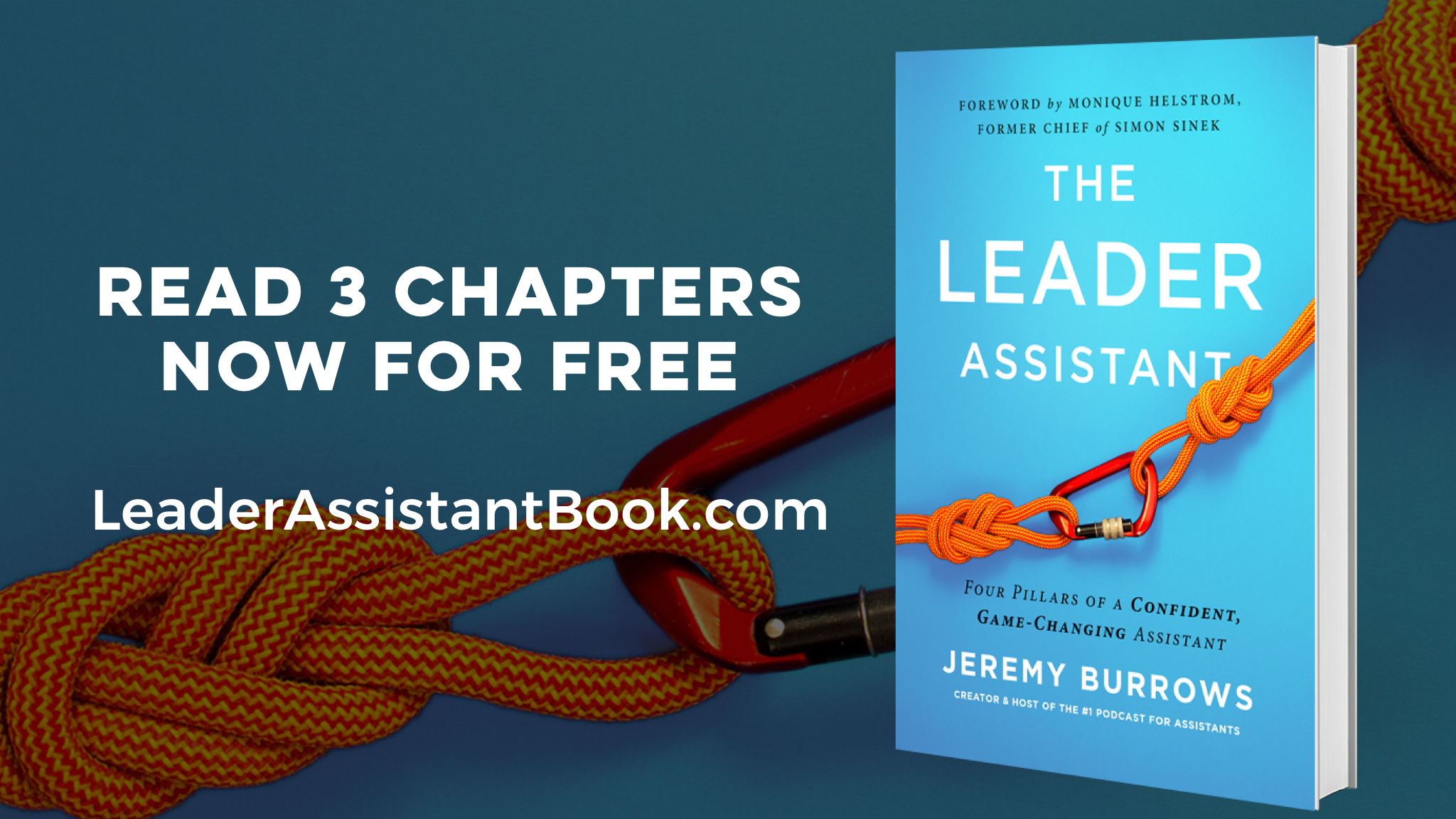
NOTE: This post is revision of chapter 7 from The Leader Assistant.